
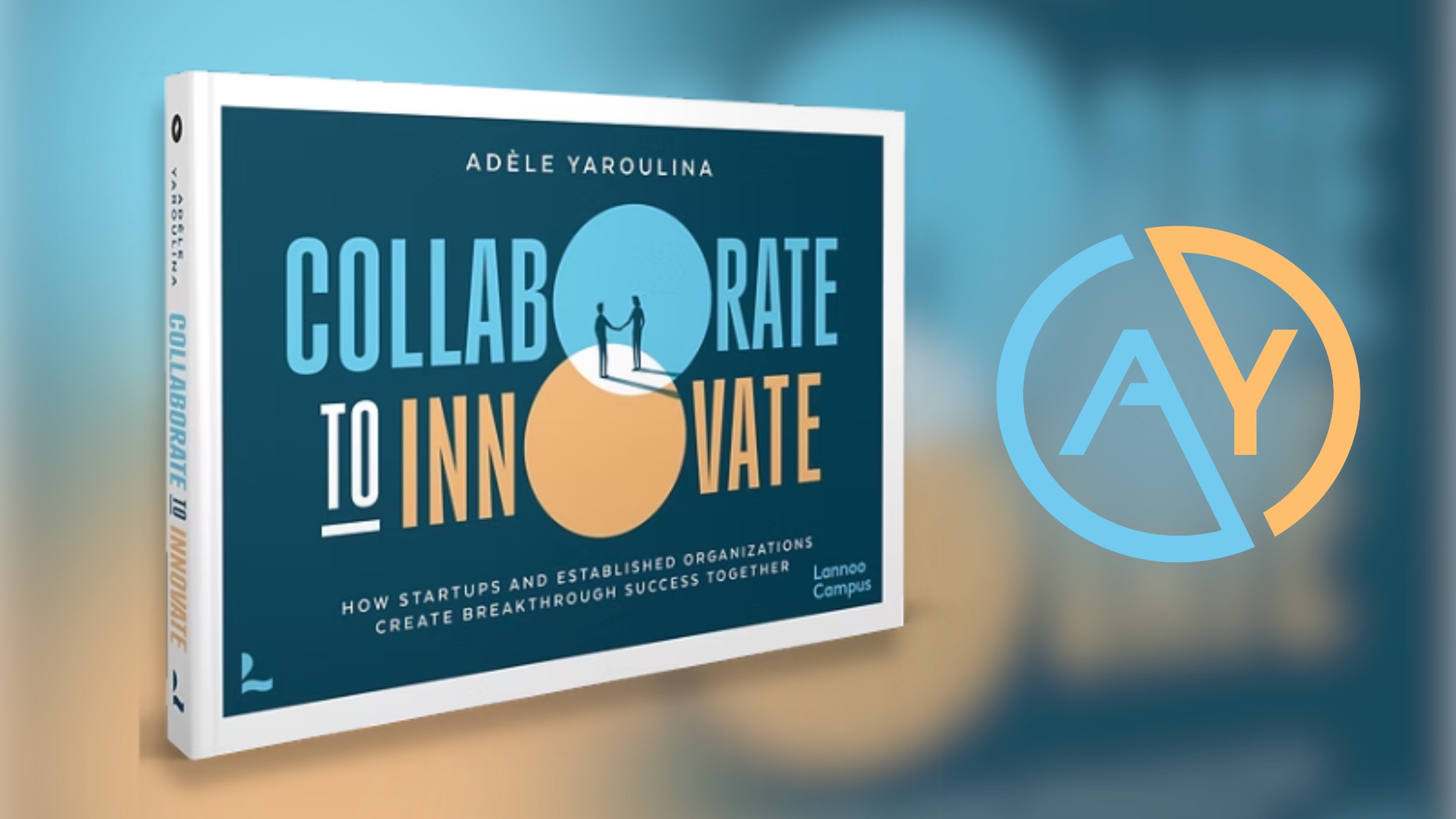
Collaborate to Innovate: Author Adèle Yaroulina
Published by VentureFuel Team on
Feb 4, 2026 9:40:05 AM
Many companies chase startups hoping for a quick win, but most partnerships fail to scale. How do you know if your innovation efforts are actually moving the business forward?
This week’s VentureFuel Visionary is Adèle Yaroulina, a global co-innovation expert and author of the new book “Collaborate to Innovate: How Startups and Established Organizations Create Breakthrough Success Together.”
In this episode, Adèle and Fred unpack what it really takes for large organizations to turn startup partnerships into scalable growth engines. They also challenge the myth that startup collaboration “isn’t worth the squeeze,” arguing instead that the real risk is chasing trends, FOMO-driven pilots, and innovation theater that never moves the business forward.
Her book provides a practical playbook for making co-innovation succeed, with real-world examples, tools, and strategies to unlock measurable growth. Pre-order the book here (U.S. edition release date: February 17, 2026.
Episode Highlights
- Turning Uncertainty Into Opportunity – Adèle explains why viewing disruption, technological change, and startup innovation as threats is a mistake, and how organizations can leverage collaboration to accelerate growth and create real impact.
- From Innovation Theater to Real Results – She outlines how to avoid superficial startup engagement and instead focus on solving meaningful problems, structuring partnerships, and aligning expectations for measurable outcomes.
- The Evolution of Co-Innovation – She shares her firsthand experience of partnerships evolving from supplier relationships to co-creation, joint ventures, and acquisitions, highlighting where real value is created at the intersection of agility and scale.
- Common Corporate Pitfalls in Startup Collaboration – Adèle outlines the mistakes large organizations make, including pursuing trends over real problems, which often derail meaningful innovation.
- Designing for Adoption – The conversation delves into how structured KPIs, ownership, and purpose-driven collaboration help move initiatives beyond one-off pilots, ensuring solutions scale effectively and overcome internal resistance.
Click here to read the episode transcript
Fred Schonenberg
Hello, everyone, and welcome to the VentureFuel Visionaries. I'm your host, Fred Schonenberg. Today, I'm joined by Adèle Yaroulina. Adèle is a collaborative innovation and co-innovation expert, author, speaker, and advisor. She helps startups and large organizations collaborate in ways that create measurable value. For any of you that are longtime listeners of the show, you know this is core to what we talk about and what we do.
But her work focuses on bridging fast-moving startup innovation with the structure and the scale of corporates, as well as the public sector. Adèle is the author of a new book, which I have on my shelf behind me, called Collaborate to Innovate, How Startups and Established Organizations Create Breakthrough Success Together. And I want to read to you what I wrote, which is actually on the back cover of the book.
Collaborate to Innovate masterfully shows how startup partnerships spark growth. Adèle shines a light on the hidden truth of corporate innovation. It's the engine of commercialization and growth. So today, we're going to unpack what it actually takes to make co-innovation succeed, everything from designing partnerships that don't stall after the pilot to building repeatable systems that drive growth. Adèle, welcome to the show.
Adèle Yaroulina
Thank you so much, Fred. Thank you for your words, for your valuable contribution to the book, and also for having me today on the VentureFuel Visionaries podcast.
Fred Schonenberg
Well, it is a pleasure. And I think maybe for listeners meeting you for the first time, can you describe a little bit about who you are, the work you're doing today, and how you've kind of found yourself at this intersection of startups and large organizations?
Adèle Yaroulina
Sure. I will indeed first shortly introduce myself. I'm based in Brussels, the capital of Belgium and the heart of Europe. And I am an expert in strategic and open innovation with a particular focus on collaborative innovation between startups and well-established organizations.
I started my career 15 years ago at a leading digital tech startup that later became a scale-up and was eventually acquired by a large American corporation. Since then, I have worked in large private companies, such as, for example, Louis Vuitton or KPMG, and in companies from the public sector, which is to say the European Commission, the Brussels government, and the European Startup Network. And today, I provide my expertise to large organizations that want to accelerate their innovation efforts through startup collaboration.
I act as a strategic advisor and as a facilitator and translator because I know how startups think and operate, and I have also been in the minds of corporates. And my role is to ensure that real impact and results materialize despite the inherent differences and complexities that may exist. What excites me most is when different worlds collide because this is exactly where the spark is created, where the magic happens, and where tremendous value is unlocked.
Fred Schonenberg
I couldn't agree more. There is a very exciting sort of moment of the collision of the different worlds, and there is a challenge translating those two worlds. So I'm excited to dive into that. One of the things that struck me is that we very much share this mindset that the threat is the opportunity. Again, I'm going to read from your back cover of the book, but disruptive innovation and digital transformation are reshaping today's business landscape. But with the right partners, these challenges become powerful opportunities. Can you talk about that a little bit?
Adèle Yaroulina
Indeed. And here I would like to start with the title of my introduction, which is, according to me, says it all. It is Think Ahead or Fall Behind. We live in unusually uncertain and confusing times, and businesses are facing technological disruption but also societal shifts, economic uncertainty, economic volatility, and paradoxically, playing it safe has become one of the biggest risks.
And as I say it in the book, those who resist change risk fading into the obscurity overshadowed by the bold visionaries shaping the future. More than ever, organizations must embrace agility, adaptability, and a willingness to seize new opportunities to stay ahead of the competition. And innovation is a powerful force that is shaping the world we live in today. AI, as you know it, and other transformative technologies are evolving at an exponential pace, and ambitious tech startups are disrupting entire industries from the bottom up. But instead of seeing startups as a threat, as competitors, bold, most forward-thinking leaders see them as partners.
By teaming up with entrepreneurs, they turn uncertainty into opportunity and secure future growth. And this is why we are seeing more and more established organizations accelerating innovation through startup collaboration. Collaboration is, as I have already mentioned it, according to me, where the value is created. It is actually the sweet spot where agility meets scale. And that is where the magic happens.
Fred Schonenberg
It's so interesting. There's so much in there that I want to pull apart because it's fascinating. I think the uncertainty equals opportunity is such an important thing to think about. And I think a lot of organizations, large organizations, understand that. But how do they move that from an understanding to action?
And maybe if you could share a core idea from the book around that concept, right? I think most leaders, certainly senior leaders, understand what AI is doing, the risk of AI. But a lot of them are doubling down on their internal, we're going to build the solution ourselves. And so how does the book advise those types of leaders to maybe look outside of their own four walls?
Adèle Yaroulina
So indeed, co-innovation has an immense potential, but it is complex. Indeed, I have to admit it, it is not easy for large organizations and for startups. And so as you have asked it, the core idea like behind the book, and the core idea is that when startups and large organizations work together and do it right, and I explain it, of course, in details, how to do it right in my book, they unlock value, they accelerate growth, and create meaningful impact together.
And the book shows exactly how to make those collaborations happen and how to make them succeed. I would like to also mention maybe shortly who this book is for, so that it creates maybe more clarity. So the book is for leaders and teams in large corporations, large organizations, actually from the private and the public sector.
It is for startups looking to understand how large organizations think and operate to get a bit in the corporate minds. It’s for university students, incubators, accelerators for research, innovation centers, startup networks, and actually anyone curious about collaborative innovation between startups and large organizations, and anyone who wants to make it happen and to learn how. You also had another sub-question that you mentioned. Maybe I can ask you to repeat it, please.
Fred Schonenberg
Yeah, I think maybe I'll adopt the question or adapt it slightly. One of the questions I have for you is what inspired you to write the book? And was there a pattern you were seeing? Obviously, you've been doing this for a number of years. The ideas of startups and corporations working together is certainly not new, right? It's something that's been around with different iterations for over a decade at least. What sparked you to go, gosh, we need a better playbook for this?
Adèle Yaroulina
Yeah, it all started actually when I was working at that leading startup, digital technology startup, and where I have seen firsthand collaboration succeed. I was then at the startup side, and the format of collaboration was at that time mostly procurement, meaning that the startup was the supplier, and the large organizations, mostly in my case from the private sector, were the clients. And then a bit later, so a few years later, those collaborations evolved to more.
It evolved to co-creation, even to joint ventures and ultimately, as I have shared already in the beginning, it evolved to acquisitions. So this is indeed the first time I was witnessing firsthand co-innovation successes. And I have to say, it all happened, from procurement to co-creation, as we were building as a startup trust with corporates, and we were having this role of advisor, and we could really co-build together with the corporate, co-build solutions, products or services.
And then after that experience, I continued further because between 2019 and 2023, for almost four years and a half, during my time at the European Startup Network, I had the opportunity to research co-innovation in depth and to design pioneering programs with partners from business and academia across Europe. And at that time, we developed a massive open online course, a MOOC, and a masterclass on the topic of co-innovation that reached more than 2,400 learners in over 140 countries.
So there was real interest, real traction for the topic of co-innovation, and that was really interesting to witness. It was, again, one of the first times where I wanted to make a difference. I would like to add that during that time as well, I led the development of the digital co-innovation toolbox, including the co-innovation builder, the CIB. This is a very hands-on tool to structure startup corporate collaborations.
And since then, the interest grew among my audience, of the public, let's say, and the CIB has been used in nearly 200 countries to support partnerships across industries and sectors. And to answer your question, and not to be because I can talk lengthily about this, what really inspired the book. So as I was saying, interestingly, this work, all of this work, practical and research, instead of tempering my curiosity, it only gave me the desire to investigate further.
Two, it amplified it. So one question kept obsessing me. Why do certain collaborations happen and succeed? And I have witnessed many firsthand. And why some others still struggle or become so painfully complex, so painfully difficult to navigate. I was also getting tired of the persistent narrative that working with startups is too risky or destined to fail. I found that it didn't match reality.
And when it is done right, again, co-innovation works. And it works extremely well. And this is why in October 2024, I decided to write this book and I wanted to bring the co-innovation builder, so my tool, to a wider audience, as I said, and turn these years of practice, of research, of hundreds of conversations I have had with different stakeholders, plus more than 100 interviews that I have conducted in the frame of the book with open innovation, innovation and startup leaders, I wanted to turn it into a real world playbook.
And that's what makes the difference, is that it is very practical, hands-on, real world. So there is no dense theory, no academic jargon, but just a hands-on guide to help people make co-innovation actually happen and succeed.
Fred Schonenberg
One of the things, and I was flattered to be interviewed by you. I loved your questions on it. I think it's such an interesting topic. One of the things I see, there's that narrative that you just talked about, which is that the risk isn't worth it, right? I used to say the juice isn't worth the squeeze. And so the corporate just ignores it.
There's another risk that I see frequently, which is what I call innovation theater or the startup petting zoo. And this is the like, we should work with startups. Let's do a pitch day. And the startups all come or the corporate all go to some hub and they see a bunch of startup pitches and it's like going to a petting zoo. They pet the startups on the head. They then go wash their hands and go back to their job and nothing happens. How do you advise corporations not to be in that innovation theater or petting zoo and really start to think about this as a way to drive tangible business outcomes?
Adèle Yaroulina
Indeed. So to avoid innovation theater and try to create real traction, as you say, my biggest advice would be do not start with the trend. Start with a real problem worth solving. I see too many organizations still jump headfirst into the latest sexy technology or trend out of FOMO or for many other reasons. They organize feverish hackathons, innovation breakfast, innovation prizes or quick fix pilots hoping to stumble upon the miracle solution, you know? And none of that is bad in itself.
I'm not particularly against it, but when it is done without a purpose, impulsively, without a clear strategy or a business need, from my experience, it almost always leads to flimsy outcomes. And real traction, according to me, comes from being intentional. That means taking the time to define your innovation slash co-innovation strategy, taking the time to understand first and then clearly articulate the challenges that are worth solving.
And also honestly ask yourself, ask yourself whether the startup is the right innovation partner in the first place. Because even the best startup, the most growth promising startup won't succeed if you bring it to solve the wrong problem at the wrong time. I always say it.
Finally, structure the collaboration properly. It's very important to address the tough, uncomfortable questions early on in the beginning of the collaboration. Questions such as governance, expectations, decision making, KPIs, timelines and sometimes that means working with a facilitator who can help ensure that both sides are aligned, this is important, and collaboration ready. That's when innovation stops being innovation theatre and starts delivering real results. I share it from my experience and it is my opinion, it reflects my opinion only.
Fred Schonenberg
Oh, that's a good opinion, I don't disagree with a word of that. And I think the big thing, starting with real problems worth solving, is often a mistake. That's the first mistake, if they're chasing the latest fad, they're doing something because someone told them to do it, and you go through this whole process and there's a solution, but the problem's not worth solving, so nobody moves forward. It's a frequent problem. Let me ask you this, is there one problem or mistake that you see corporates make most frequently? Like if you had to give a watch out for anyone that is early in this journey, where do most stumble?
Adèle Yaroulina
Well, there are many mistakes, I have to say, I see corporates but also startups making when entering, when engaging with each other. But I will focus on the corporate side as you asked and highlight just a few, because this seems like it's not rocket science, it seems logical and it seems easy, but I still see what I just said earlier, for example, not defining the real challenge worth solving and other mistakes as well.
So one common mistake, as I said, I will not be too lengthy, but I will just mention a few that I see most, at least in Europe, is diving headfirst into initiatives without sufficient reflection. As mentioned already, so often because someone in the team, in the company, someone heard or read about the latest hype trend and then the goal becomes impressing teams, hierarchy or competitors rather than really validating whether there is an actual need, an actual business need behind it.
Another misconception is still thinking that innovation is about being creative on the surface. And I saw it a lot because it sounds quite, as I said, logical, but I still see it a lot. So innovation is not only about being creative on the surface, so meaning snapping selfies, for example, at demo days, I exaggerate a little, but not so much, or speaking startup language to appear credible or wearing white sneakers with a suit. Real innovation is about content and it requires patience, discipline, that's very important, structure and the right tools as well.
Another thing is that I still see corporations frequently treating startups as free consultancy, free consultants, rather than equal partners from the beginning. And finally, one important thing is the lack of honesty that I witness on the corporate side. It seems to be a recurring issue. So showing great enthusiasm, for example, for an idea and giving startups false hope for weeks or even months, in the best of cases, without anything concrete behind it. So no real need, no internal sponsor, and no clear commitment. These are a few mistakes that I keep witnessing.
Fred Schonenberg
All right. I'd love that. Maybe this dovetails off of it. The step after a pilot or that initial test is often where we see innovation really struggle, trying to move to scale up, right? You talk about measurable results. And I think that in a lot of ways, you can create a sandbox, a place to do a pilot. But one of the challenges that we've been tackling for a number of years on our side is like, it doesn't really matter unless it gets to scale, internally and for the startup, right? They're always looking for that next step.
And there is an internal friction in these large legacy companies, what I would call not invented here syndrome, that unless it is new and something they've never done before, you get into the internal world of like, well, couldn't we build this ourselves? And so I'm curious what your advice is for that jump from the pilot that maybe has some promising results or outputs to the scale up where you move from vendor to partner. What do you see there that is worth sharing from your experience?
Adèle Yaroulina
Yes, you were talking about measurable. And that is indeed an important part of my work, because I believe KPIs and milestones are absolutely key. And I will start with that. It's a key part of the collaboration. And here I would like to talk about the co-innovation builder, the CIB, the tool I co-developed. And in the CIB very shortly, so just for some context. So there are three sides.
There is the startup side on the left, the corporate side on the right, and in the middle part, you have the collaboration part. And first, I invite startups, and I invite the large organization to reflect individually on essential elements, essential components of collaboration, which is the drivers, the intention behind the wish to collaborate, the deciders, very important, the contributors, the resources that they have, and the returns, ROC, I call it the return on collaboration that they expect, that they want. So these are the individual sides.
And then you have the collaboration side. And this is where I'm getting it that both partners have to sit together for that middle part and reflect on key critical elements, such as goal, common goal, such as format, such as outcomes, risks, not easily mentioned, very uncomfortable, and on KPIs and milestones. And this is an extremely, as I said, important part of the co-innovation builder, but also any collaboration to define this. Because these metrics are, as I'm sure, the backbone of accountability.
And honestly, before developing the CIB, and before testing it with thousands of organizations, I do not see, I did not see, and I do not see many co-innovation tools that put enough emphasis on this, on the KPIs, milestones, risks, and tools that push really the discussion about those elements in the very beginning of the collaboration. And without clear KPIs and milestones, I know from my experience that collaborations stay vague very quickly.
And they help define the scope of collaborations and clarify expectations and keep both partners aligned, of course, and moving in the same direction. This way, they can really monitor progress from the beginning, and then come back to the tool, iterate to the pilot, actually. It allows them to spot issues early and adjust the collaboration as it evolves. It also helps both sides to develop a really realistic understanding of what it really takes in time, effort, cost, to reach those shared goals and outcomes that they have defined before, also with the help of the co-innovation builder. And these KPIs should not be static. They should be updated as the collaboration progresses.
And in my book, I give a few examples. Of course, I give many examples of KPIs. And this is not an exhaustive list. But KPIs can be, they have to be concrete and precise to work. It can be the number of experiments, for example, launched, but to validate a value proposition by a certain date. So, very precise. It can be the number of customer interviews, user tests completed, the time from ideation prototype.
There are many examples of the KPIs, and they can be different according to the stage of the collaboration, of course, scouting and engaging partners, stage collaboration design, exploitation of solutions, et cetera. Now, maybe I didn't really answer the question. Also, the second question about how to go beyond the pilot.
Fred Schonenberg
Yeah, I think the thought I had is I think everything you just laid out is hyper critical for this to be successful at all. I guess the question I'm asking is, what happens after that? So, you built the KPIs, the startup hit it, the innovation team or whoever is the internal corporate client who approved the program has their case study.
Then all of a sudden, it gets handed off to the business unit or gets handed off to the internal R&D team as a validated here's the thing. And they've, of course, been working on other things. They are not compensated for integrating this tool. Are there any secrets that you're seeing about that? I think what you just described is the zero to one best case scenario. What's the one to 10 jump?
Adèle Yaroulina
Indeed. So, one of the reasons that I see to start with, first of all, one of the reasons collaborations get stuck at the pilot stage is that they are often designed as one shot experiments, not really as we call it paths to adoption. And to overcome the challenges that you mentioned, I think teams have to shift first their thinking from running pilots at all costs to designing with purpose and for scale, like from the very beginning.
And there are many challenges and you mentioned, for example, the legacy challenges, like the not invented here mindset or a strong focus on the profit and loss, new term profit and loss. But here, I want to say that to overcome these challenges that we mentioned, teams need to shift how they approach those pilots. They need to design their collaborations with purpose. This is very important with ownership also and a clear link to the business, to the business needs from the start. I think ownership is critical indeed that internal teams must be involved early and given responsibility and not just asked for feedback at one point in the process or in the end.
I think this is very important because when people feel, when the members of the team and leaders as well feel ownership, then resistance drops, of course, especially, the instinct, natural instinct to reject something simply because it did not originate internally. Another key factor, and I have said it already and I would like to repeat it, is a clear problem definition. And I say it again here because I find it important in this context, is that I heard, and I heard it repeatedly in interviews with leaders from large organizations, is that without alignment on the real business need and the strategic roadmap as well, as I said, even great solutions, even great startups eventually get challenged and the progress stalls.
And I heard that a lot, actually, despite the fact that this was mentioned… it has been mentioned numerous times in the literature or when working… When working with large organizations and startups, this is something that gets mentioned often, but still it is one of the biggest challenges, according to me.
Fred Schonenberg
Yeah, I love that. I think that purposeful design up front, that it is not just about the pilot, that you're thinking of the long-term adoption, that path to adoption as a really powerful idea for listeners to take away. And I have sort of two questions to end on here. One of which is, what do you hope that listeners take away from this conversation? Besides going to buy the book, which we will provide the link to, what's one thing you would hope the listeners take away from what we've talked about today?
Adèle Yaroulina
The key idea that I would like listeners to take away is that co-innovation between startups and large organizations has huge potential. And you can see it in my book through the dozens of real-world testimonials from open innovation, innovation startup leaders, that it works. It has huge potential. However, it is complex. It is very difficult. It can become really painful.
And it is very important at that point, one of the key ideas that I would like to transmit here, it is important, again, to do it with discipline, with structure, alignment, and especially with the right tools. And to discuss very uncomfortable issues up front and to be honest about that on the corporate, but also on the startup side, to be honest with each other.
And this really saves time, energy, money to be collaboration ready and to align before the collaboration even starts. And to have the courage, actually, to stop the collaboration before diving into it. If it doesn't meet, for example, the resources or it doesn't meet the drivers, I think it's important to be able to structure and to align, that we cannot leave co-innovation to good intentions and to just chase the latest trends. And this would be my core idea.
Fred Schonenberg
I love that. I think it's very, very valid and important. Let me ask you this. Where should people go to find out more about yourself or to go buy the book?
Adèle Yaroulina
People can go, indeed, you can go on my website as a first name, which is www.adèleyaroulina.com. So this is my website where you can find more information about myself, about the book, about the services I provide. And you can also buy the book there, but you can also purchase my book from the beginning of March in the United States on Amazon at Barnes and Nobles or Simon & Schuster.
Fred Schonenberg
Very cool. Well, it's a great read. I highly recommend it for anyone listening. And Adèle, thank you for taking the time to unpack some of the insights that are in there and to share your perspective and the tools that you've created over this. It's incredibly helpful and I really enjoyed the conversation.
Adèle Yaroulina
Me too, Fred. Thank you very much for the opportunity.
VentureFuel builds and accelerates innovation programs for industry leaders by helping them unlock the power of External Innovation via startup collaborations.
Tags:
Innovation,
podcasts,
Startup,
VentureFuel Visionaries,
Founders,
Corporate Startup,
Accelerate Growth,
Entrepreneur,
visionary,
Corporate Partnerships