
You can read the very well written and researched article in "Stop investing in startups. Become their customer instead" by Serguei Netessine, Valery Yakubovich, Claudio Garcia, Gary Dushnitsky published in Fortune by clicking here. Keep an eye out for our interview with Serguei, which will be released next week.
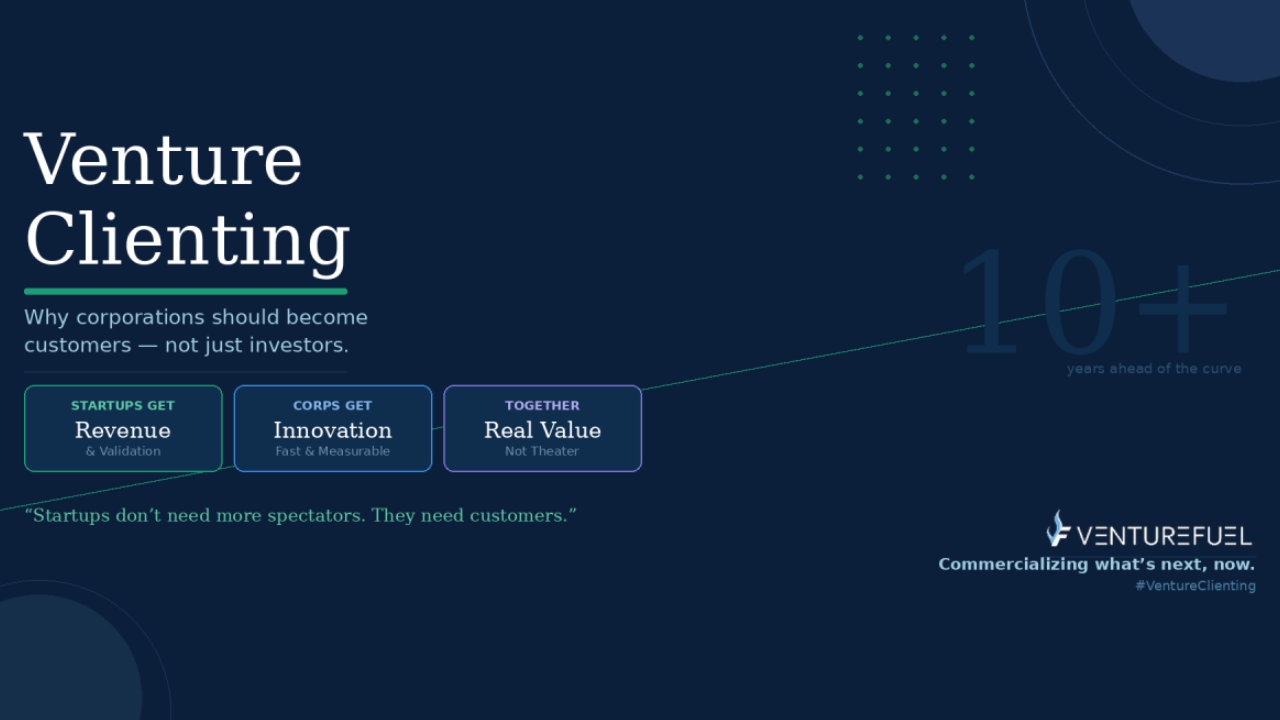
Venture Clienting Isn't New. It's Finally Getting the Recognition It Deserves.
Published by Fred Schonenberg on
Jul 16, 2026, 2:36:21 PM
A recent study from the Mack Institute for Innovation Management at the Wharton School, later featured in Fortune, validates something we've believed at VentureFuel for more than a decade: the future of corporate innovation isn't just investing in startups, it's working with them.
The research examines the evolution of corporate venturing and highlights the growing importance of venture clienting, the practice of corporations becoming customers of startups rather than investors. While venture capital remains an important tool, the authors argue that the most effective corporate innovation strategies increasingly combine multiple engagement models, including venture clienting, accelerators, venture building, and corporate venture capital.
The Future of Corporate Innovation Isn't Just Investing in Startups
In many ways, VentureFuel was built around this idea before "venture clienting" became part of the innovation lexicon.
The VentureFuel founding story begins with a conversation with a founder telling me about the accelerator program they were in – I didn’t know what an accelerator was. He told me about the value exchange. He had given meaningful equity in exchange for mentorship, office space, and a press release.
My response, while naïve, was simple:
"There is a better way to fuel your venture, go get paying enterprise customers!"
At the same time, I was hearing from executives at large corporations returning from innovation tours in Silicon Valley.
They had visited startup hubs, attended demo days, and collected stacks of business cards.
Yet many came back frustrated.
They had enjoyed what I call the "startup petting zoo," but very few had solved any business problems or were going to do anything meaningful with the startups.
The Disconnect Was Obvious
Startups didn't need more spectators. They needed customers.
Corporations didn't need more innovation theater. They needed solutions.
That's where VentureFuel was born.
From day one, our belief has been that innovation should start with a problem worth solving.
Once you understand the challenge, you can identify the best solution, whether it comes from a startup, an emerging technology, or a co-developed new solution.
More often than not, startups have been the source of those breakthrough solutions because they are singularly focused on solving specific problems faster and better than the status quo.
Venture Clienting Is Receiving the Recognition It Deserves
Today, venture clienting is finally receiving the recognition it deserves.
The Wharton research highlights companies like BMW, Bosch, and Walmart that have built sophisticated programs to source, pilot, and scale startup solutions without taking equity positions.
We have run over 100 of these corporate-startup collaborations that create value on both sides:
- Corporations gain faster access to innovation.
- Startups gain revenue, product-market fit validation and a pathway to scale.
But the most important insight from the research is that venture clienting shouldn't be viewed as a replacement for corporate venture capital or other innovation vehicles.
The best organizations don't choose between:
- venture investing
- accelerators
- venture building
- open innovation
- venture clienting
They build a portfolio of approaches and deploy them intentionally based on the outcome they're trying to achieve.
That's exactly what we're seeing with the most successful innovation leaders today.
The Best Organizations Focus on the Problem First
The companies outperforming their peers aren't asking,
"How do we engage startups?"
They're asking,
"What problem are we trying to solve, and what's the fastest path to value?"
In many ways it’s a capital allocation question.
Sometimes that answer is an investment.
Sometimes it's a pilot.
Sometimes it's a commercial partnership.
Sometimes it's all three.
The common denominator is action.
Why Venture Clienting Continues to Gain Momentum
In a world shaped by AI disruption, economic uncertainty, geopolitical volatility, and rapidly changing customer expectations, organizations can no longer afford to wait years to learn whether a technology matters.
They need mechanisms that enable rapid experimentation, measurable outcomes, and scalable adoption.
That's why venture clienting continues to gain momentum.
Not because it's trendy.
Because it works.
At VentureFuel, we've spent years helping organizations build these bridges between corporate challenges and startup solutions.
Long before there was a label for it, we believed that the best way to fuel innovation was to create real business relationships between corporations and entrepreneurs.
The terminology may have evolved.
The principle hasn't.
Innovation happens when great ideas meet real problems and when organizations are willing to act on them.
Read the Full Research
Click here to book a meeting with us or to learn more.
Tags:
Innovation,
Startups,
AI,
Corporate Innovation,
AI innovation,
Innovation Strategy,
Enterprise AI,
Enterprise Innovation,
Venture Clienting