
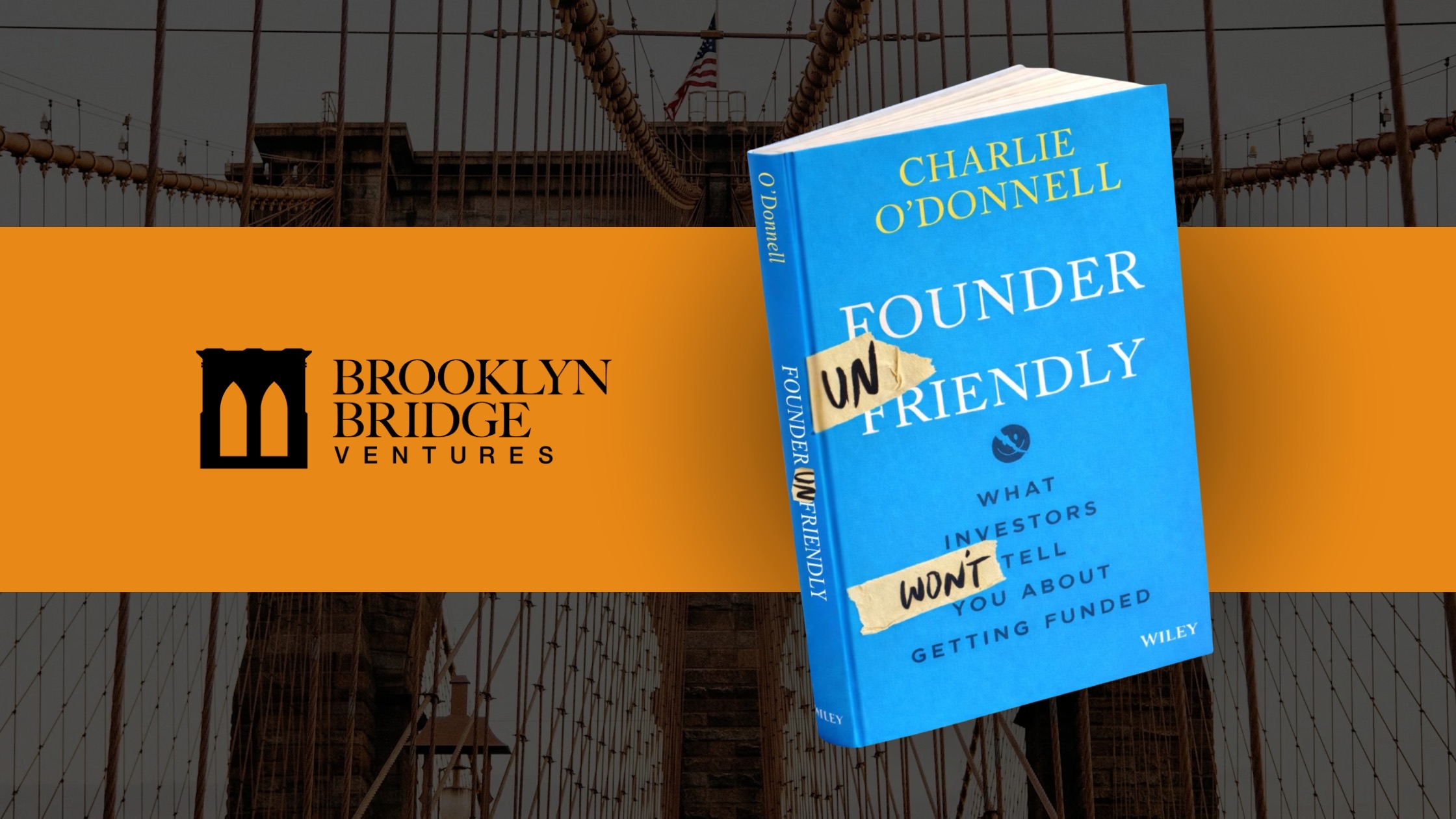
Selling Tickets to The Future With Brooklyn Bridge's Charlie O’Donnell
Published by VentureFuel Team on
Apr 24, 2026 6:00:00 AM
Raising capital can open doors, but it does not guarantee success. Are you building a real business or just winning the pitch room?
This week's VentureFuel Visionary is Brooklyn Bridge Ventures Founder and General Partner Charlie O'Donnell, one of the most influential figures in New York's startup ecosystem. With more than two decades of experience spanning Union Square Ventures, First Round Capital, and then creating the first venture capital fund based in Brooklyn, he has backed well over 100 early-stage startups.
In this all-Brooklyn episode, Charlie brings his uniquely candid and deeply informed perspective on how venture capital actually works and insights from his new book "Founder Unfriendly," where he unpacks common misconceptions about VC and how both founders and investors can build more transparent, productive relationships.
Pre-order the book here ahead of its release on April 28, 2026, to get early access.
%20VFI%20Visionaries_Selling%20Tickets%20to%20The%20Future.jpeg?width=760&height=428&name=Thumbnail%20(Podcast)%20VFI%20Visionaries_Selling%20Tickets%20to%20The%20Future.jpeg)
Episode Highlights
- Fundraising Isn’t Winning – Charlie explains that raising venture capital should not be seen as the finish line. It brings bigger expectations, more pressure, and a higher-risk path built around outsized growth.
- Selling the Future, Not the Past – He explores how investors must focus more on future potential than past accomplishments. Founders need to show how their company can scale into a major business, not just highlight current traction.
- Why “Interesting” Is a Warning Sign – He discusses that vague investor responses often signal weak conviction rather than real momentum. Honest feedback is more valuable because it gives founders something concrete to improve.
- Traction Only Matters When It Solves the Right Problem – The conversation explores that not all traction carries the same weight. Revenue, users, or growth metrics matter most when they prove the hardest and most important part of the business model.
- Better Corporate-Startup Partnerships – Charlie explains that large companies can work well with startups when they come with real business needs, clear budgets, and fast decisions. Respecting startup time creates stronger outcomes for both sides.
Click here to read the episode transcript
Fred Schonenberg
Hello, everyone, and welcome to the VentureFuel Visionaries podcast. I'm your host, Fred Schonenberg. I'm so excited today to be joined by Charlie O'Donnell. So Charlie is a long-time venture capitalist, a founder and investor coach. He spent more than two decades shaping the New York startup ecosystem.
He is the founder and general partner of Brooklyn Bridge Ventures, the first venture capital fund based here in Brooklyn. He's backed over 100 early-stage startups. And over the course of his career, from being the first analyst at Union Square Ventures to helping build First Round Capital's New York office to now coaching the next generation of investors, Charlie has developed a unique perspective on what makes startups and venture firms successful.
He also hooked me with the best email subject line of the year. Can't let it go 10 years without a chat. He and I were on a panel in 2017 during a conference that VentureFuel was helping to run. So this is a great blast from the past for me. Today, we're going to talk about what early-stage investors really look for in founders, how the venture landscape has evolved, why transparency and founder-investor alignment matter more than ever, and about Charlie's new book. So please join me for the first-ever all-Brooklyn episode of the VentureFuel Visionaries. Charlie, welcome to the show.
Charlie O’Donnell
I am super excited to be here. We should have done this in person.
Fred Schonenberg
We should have. That would have been cool. It would have required some sort of thinking about technology. It's all so easy now if it's online.
Charlie O’Donnell
That's true.
Fred Schonenberg
Well, listen, man, I said it in the intro, but you have spent more than two decades building up the New York venture ecosystem. I'm curious what originally drew you into venture, and maybe what has that journey taught you about how startup ecosystems should work?
Charlie O’Donnell
I will fully admit to pure dumb luck and a couple of things that, in hindsight, I guess, were making big, risky bets that just paid off in spades in my favor. I was at the General Motors Pension Fund, which I got through a high school internship, and my high school basically kicked us out in the third semester of senior year.
And because I went to college in New York at Fordham, I was able to stay past the internship. I would come back and work every summer, and I started working part-time during the year. And the one group, actually, that I had not worked with by the time I graduated was the venture capital and private equity group.
GM had been investing in venture since, I don't know, 1978 or something like that, and all the top-tier funds you can imagine. And they're the group that just happened to have an opening. When I joined that group, that group did both private equity, venture capital, mezzanine and distressed debt, a few other things. And I just naturally gravitated towards the venture partners who would come in, folks like Brad Feld would have eight devices attached to his belt and be talking about some crazy new technology that was going to change the world and that he was just super psyched about.
The private equity folks would come in and say, hey, we have the chance to buy this asset on the cheap and cut half the staff and ship this over to wherever country. Yeah, I mean, it's a great life. You can make a lot of money doing that, but it just didn't resonate with me as what I wanted to do. And so I was much more drawn towards venture.
And also there was a timing thing. So I saw 10 negative quarters of performance in venture before I ever saw a positive one. So I joined that group in 2001, in the beginning of 2001. And so we were just writing down companies from the dotcom era, just letting them slowly drip out and die. And what wound up happening is eventually all of the VC firms had to take their mulligans and come back to market.
And about 85% of our portfolio came back to market in 2004, so we had an opportunity to either double down in venture or get out of it entirely or switch up all our managers. And so I was on the venture team and got to meet a lot of emerging managers. So folks like Fred Wilson and Brad Burnham from Union Square Ventures, Bijan and Todd Degres from Spark, the team from Emergence, like all of these folks that were either coming out of other firms or had been doing some angel investing and then jumping into building this next generation of venture.
I got really into the guys from Union Square Ventures, so much so that I emailed Fred Wilson and said, what's a junior person in venture even do? Do I need a computer science degree? Do I need an MBA? And Fred writes a one line response. You want to come and find out? And that was it. Essentially, the bet that I was making there was on this firm, this no-name firm that hadn't even launched yet in New York, because doing venture in New York in 2004 was not an obvious bet.
Joining USV and staying in New York panned out big time. And I wasn't even at USV for that long, but the New York East ecosystem kind of grew up around me. I feel very lucky for whatever small part I had in helping facilitate community and connection. And to this day, I find out lots of things that so-and-so met their co-founder at an event that I put on, and that was sort of the initial connection, things that I didn't even know at the time happened.
But I was kind of doing a little bit out of it in self-interest, because when I joined Union Square Ventures, I had just come from the buy side, from a pension fund where I had a Bloomberg terminal and any street analyst who was willing to talk to me to get our trading dollars. And so I needed to go talk to people, right? Chris Dixon pitched us his startup, SiteAdvisor. I'm like, I didn't know anything about the browser security space or fraud. But Sri Mahesh, who is now a partner at Spiro Ventures, I had just met, was connected to a guy named Jeff King, who worked at eBay at the time. And I was one of the first 10,000 users or whatever of LinkedIn.
And Jeff was very excited to talk about fraud. That's all he thinks about, right? And so I had to learn like, oh, there's somebody in the world who knows way more about fraud than I do. That's the person I talk to for due diligence, right? I realized that if I was going to succeed in venture, I needed to get to know a lot more people. And so I started becoming a community builder and showing up on other people's panels and running them on my own and running events and just trying to really build out my network as a matter of necessity. And a lot of great things have happened from it over the last 20 years.
Fred Schonenberg
I think it's really interesting. We talked offline before we started about AI and how fast things are changing. One of the things that I sort of believe I think is interesting is the idea of ecosystem and community being something that's very hard to replicate. It can be enabled by AI, but it's hard to replicate. How have you seen this startup ecosystem in New York or otherwise evolve since those early days? And do you think that that is, is it that community and sense of connection that sort of differentiates what works and doesn't?
Charlie O’Donnell
Yeah. So New York has gone through a few different waves, right? And at first there was the expectation that New York's community was sort of largely driven by Wall Street and the financial community. After the 2008 financial crash, we kind of disproved that because actually the people who scattered from banks went off and built lots of different things and followed their true passions, which may not have been working for Chase or Goldman or whatever, right?
And the thing I've always liked about the New York ecosystem is that it's very open and it isn't, you know, if you think about the Bay area, right, there's a center of that community. Whether it's YC or a very limited group of small funds and Sequoia and Stanford, and you can kind of tell how close to the center you are. It's not like that in New York at all, actually. And people in the ad tech space don't necessarily know the people in the FinTech space and the FinTech people don't necessarily know the healthcare folks.
Even if you are the center of the health tech community, right, you're still not as big a time as the chairman of Northwell Health or whatever, right? So we're embedded in all of these industries and communities and there's all this sort of crossover. And also layered on top of that is New York is an easy place to get around. You know, you try to run a meetup in LA and it's like, well, what time is this meetup going to be? Because I got to beat the traffic.
Fred Schonenberg
Right. It's five minutes away or three hours away, and I'm not sure which.
Charlie O’Donnell
Right. Right. And it's not like that in New York, right? In the middle of rush hour, anybody can get anywhere, right? And they might even come to Brooklyn for, you know, your event. And so New York has always been a very accessible community in that way. I think it's really interesting to see what happened during the pandemic, because you had this instance where if you ran an IRL community in New York before the pandemic, it was kind of a good solid almost three years later before you were able to really reconvene that community.
And things have really changed over that time period, right? Like probably a third of those community people were going to leave anyway because they tried to start up and it failed and they went back to, you know, that agency or wherever they were working. Probably a third of those people left New York. They decamped to the Burbs or to other places and then very quickly regretted it and came back.
And, you know, and then there's always these new folks. There was this young crowd of crypto folks or college grads that all of a sudden Manhattan rents were way cheaper than they ever were before. So they're like, cool, New York at this price. I'll move into this FiDi apartment with my eight roommates and make it work. So this very dynamic changeover right when there was like all this technology change happening, whether it's crypto or AI or all of this sort of stuff.
So it does require you to really stay on top of networking and, you know, who's out there and connection. And to some extent, I think with some of the AI tools, it's actually incredibly helpful for me to convene community at scale using AI tools. So it's not disintermediating the in-person. It means that I can convene a dinner with a bunch of VCs talking just about the trade or getting to know somebody who's got 20 years experience in it.
Because it's very easy for me to send out 50 invitations and have Claude core capture the responses at scale and make sure that everybody is actually coming in and double down on confirming attendance. And if I can make Claude co-work do that, then Vanessa, my assistant can move up to, you know, bigger and better things than just tracking the fire hose that's in my inbox, you know? So it's been really amazing to see.
Fred Schonenberg
That's very cool. Well, so I want to turn to your new book, Founder Unfriendly. Within it, one of the things you argued that I loved was that fundraising isn't really a game that founders win. It's more about alignment with how venture capital actually works as a financial model. And then I just found this to be so interesting because I remember talking to early stage founders and they were like, I just raised XYZ. And I was like, yep, cool, game on. Like, there's a lot of responsibility that comes with that and expectations. So I'm curious, from the book, what do founders misunderstand most about what happens when they win raising?
Charlie O’Donnell
I was doing a panel last night and somebody asked what's the sort of criteria for venture, what makes me venture backable? And I asked the room, how many of you are comfortable with this thing going to zero? And out of a room of 60 people, two people raised their hands. I said, you two folks are the only people who should raise because, and they were all like, you should imagine the looks that everybody had when I said that, and they were all totally thrown off.
And I said, here's what happens when you take a venture. You ramp up the potential, right? I give you growth capital and hopefully this thing becomes a much bigger thing. But I'm also turning up the chance that this might be zero. We're swinging for the fences here. We're taking some risks. And if you are trying to build a business where you literally cannot handle a zero for any number of reasons, right? You want this business to survive, to pass on to your kids. You literally are in a financial position where you can't afford to spend five of your highest potential earning years on something that might outcome in a zero. Then venture's not for you because you've signed up to a risk-taking endeavor.
And look, the guys from Blank Coffee would not have been satisfied to open up three coffee shops and run them cashflow positive for the next 20 years. That was not their ambition. They are creating the next Starbucks or wherever they want to position themselves in the ecosystem and their goal is to have 500 locations where they can go big or go home. And if that means unprofitability for some period of time, because they are fueling growth versus profit, so be it. But that's the goal. And that is the kind of capital that venture is and it necessitates that because that's the cost of capital of the people who you raise money from.
Fred Schonenberg
Tell me a little bit about the book. What inspired you to write it? What do you hope people take away at a high level?
Charlie O’Donnell
So the book is called Founder Unfriendly. And the unfriendliness comes from the fact that many times on a venture pitch panel, I have been called Simon on the panel. And I think that, I don't know if it's my Brooklyn roots or just my innate personality, but I'm pretty direct with people.
I remember one time a founder was pitching in some public forum. It was probably the fifth time I'd seen him pitch this thing and he'd been at it for a year. And he was effectively going head to head with Amazon in some way. I don't remember exactly how. And he didn't have a co-founder, no investors, like this thing wasn't going anywhere. And I literally stood up and said, I am closer to backing you to do anything else but this than I am to backing you for this. Half the people in the room thought that that was the most horrible thing you could ever say, but that is the most useful thing that anybody told that guy. And nobody is really incentivized to say that because what if he figures it out?
You know what, the chance that he might think I'm a jerk versus the chance that maybe he stumbles into it. Most VCs were like, well, it's interesting. Let me know your progress, all this other BS. And I'm just not wired that way and I want to help the 99% of founders in the room who struggle to raise, because I find their time valuable. And if it means saying, hey, I don't think this one's it. I think you have a better idea in you or literally don't quit your day job for this. I wanted to get that out there.
And I wanted, you know, I just wrote a post this morning and somebody responded back and said, this was hard to read, but I appreciate it. I was like, nailed it. That's exactly what I'm going for. If you read an entrepreneurship book and it gets you excited about venture, throw it out and do not recommend it to anybody. If you read an entrepreneurship book and you're a little depressed after reading it, then that book has been honest with you about where the bar is and how hard things are and the amount of work that you need to put into it.
And this to me is my attempt at scaling all of the one-on-one conversations that I've had over the past, where founders would come back to me and say, hey, you know, I disagree with everything that you said, but you're the only person who gave me real feedback. I'm going to prove you wrong, but thanks. And that's my hope for how people feel after reading the book.
Fred Schonenberg
I think it's so interesting. I get approached all the time, both from the we're raising money, but also, hey, I'm thinking about starting a business. And I'm always like, don't. And they're like, what? I'm like, you have no idea. You have no idea of all the difficulties and all the things. They're like, yeah, but I have one client already. And I'm like, yeah, you have to take whatever money you make from that client to put it in to get the next three, because that one might go away. And by the way, now you're running three and you need somebody to run biz devs. Whatever money you get from that, you've got to put it to that. You go down this road and it's like, you got to really want this. And you have to be wired a little bit crazy, a little different to be an entrepreneur.
So let me ask you this. What do you think VCs are saying when they give them, hey, you know what? Interesting. Get back to us at a later date.
Charlie O’Donnell
Interesting is the worst thing ever. You do not want to be interesting.
Fred Schonenberg
No.
Charlie O’Donnell
Do you know how bad you need to be for a VC to say, this is not interesting. I mean, really bad, because like I said before, you might figure it out, right? If you were a credible person in an interesting space, you're the next Stewart Butterfield who twice tried to build games, some version of a game. And the first time he did, he pivoted around. He built Flickr and sold it to Yahoo. And the second time he pivoted around and built Slack. And you know, who wants to be the idiot who tells Stewart Butterfield, this is not interesting. You're not interesting. Never come back to me.
That's bad business actually. And what you really want is don't go. You know, we should be working together like right there in the meeting. And that happens. What founders don't realize is that it happens because it happens really rarely. I saw 2000 things in a year. It'd probably take about 200 pitch meetings. I'd probably do real work at like 30. And I would write checks to 10 and I had a fairly brisk pace. So like 10 out of those 2000 got to see what happens when a VC is really excited.
Fred Schonenberg
I have a guy that teaches entrepreneurship at Harvard business school. Really, really great guy on the show. And we talked about this idea of founders and any salesperson who has happy ears. So they hear something interesting and they're like, I'm on it. I got it. Like I just need to send a better email or show a little progress. Like I'm almost there. How do you help founders think through that and, and realize that maybe, Hey, this is a brush off versus they need to keep working on it until they get somebody that grabs them by the collar and says, let's build this together.
Charlie O’Donnell
So it's interesting. You brought up sales because really good salespeople do not have happy ears. The best salespeople, I backed a company called single platform and the number one salesperson at single platform and anyone who's worked for a single platform knows who I'm talking about, did not have the highest close rate, but she had the highest volume rate. And the reason why she had the highest volume rate is because she got the customers that were going to be a no off the phone quickly, more quickly than anybody else. And that is a skill.
So you need to go into a conversation like a salesperson who says, this is what I let, let's establish that we're a fit. I'm going to tell you a little bit about what we're doing. Then after that, you know, you can let me know whether you want to keep going in this conversation. I'm hoping to prove A, B, and C. And at the end of the conversation, you circle back and you say, if you remember, I hoped to prove to you A, B, and C. And we agreed that if I did, you'd be pretty interested in this thing. What do you think I did? Do you believe in A? Do you believe B? Do you believe in C? And when then you get real feedback on where you hit and where you missed, and you know exactly where you stand and you're literally asking for the negative feedback, please tell me which of the A, B, and C things you do not believe.
I may have an objection to that that is either convincing or not, but there's no reason why we should be in a place where I have no idea what you're thinking. And you're giving me this high level brush off kind of feedback like that. That is a sales failure. And that's somebody who does not know how to sell.
Fred Schonenberg
Yeah. It's very interesting. So, let me ask you this. I'll stay on the sales commercialization side. As an investor, how important is commercial validation when a startup comes to you, obviously at very early stages, you know, maybe it's idea stage, it's not there, but sort of like that next level where they have a proven that, how important is it to see commercial traction, especially like a B2B type of startup?
Charlie O’Donnell
Traction's really hard because it is probably the thing that most confuses founders. It's very easy to look out and say, Hey, I have some customers, this guy over here, he got backed. He doesn't have any customers. I'm further ahead. Why did they get backing? First of all, venture capital is a… you're selling tickets to the future. It's not a reward for the past.
Fred Schonenberg
Yeah.
Charlie O’Donnell
Okay. So you, 80% of this meeting has to be about what you're doing going forward. The fact that you may have convinced one or two enterprises or however many to do this, those might be the only two enterprises on the face of the earth that had this problem. Or how do I know that your uncle doesn't run one of them? That's the way you sort of got in and the allocated budget for you.
The other thing is like, not all traction's created equal. There are plenty of companies who pitched me where I was like, yeah, I believe your one-off pizzeria is going to buy this thing, but I just don't think Morgan Stanley is going to buy it. And I think the only way you make this work is by successfully winning an enterprise. And then the founder would come back six months later. And let me tell you about all the growth. We signed up 360 more pizzerias. Cool. But that's not, that wasn't my issue.
Actually, you still haven't proven the specific hard thing that I was trying to get you to do, or that I think you need to do to be successful. I could be wrong. But, um, the other thing is that the type of traction, maybe it's not even revenue, right? Maybe it's like, I've probably pitched 10 different versions of digitizing my closet and helping people figure out what to wear for any number of reasons for creating a resale market for recommendations. No one has successfully made it super easy for me to just walk in with my phone. And 10 minutes later, I got all my items, you know, on the phone.
There's a company called Pickle. That's sort of in that business now. Maybe I haven't tried it. So maybe they have, um, that's the hard part. And so you could be a great consumer marketer and you can say, this is what we're building. It's the closet digitization tool. We have 50,000 email signups ready to launch into our beta, right. But nobody's using the product.
I think if somebody came to me with 50 users who were just like, I could not believe how easy it was to get all my clothes on this thing. I think I'd take the app with 50 users actually, because they did the hard part that no one else had been able to figure out because what good is it to send an app to 50,000 people that doesn't get over the hurdle that everyone else has had in the space, right? You're just gonna fail. And so that's not always obvious to founders, but the best founders come in and say, this is the thing in the space that no one else has, um, figured out.
And we have, and they actually, they kind of tell an investor what to think. You know, so many people come in and they, you know, uh, is this something you tell me? Dude, I'm not an expert in radiology or, you know, um, uh, maternal health after postpartum, you know, whatever. I'm a son of what my wife went through, but like, you tell me about the space; you're closer to it. I hope you're closer to it than I am because I'm not close enough to anything to be a founder.
The best founders sort of say, like,here's how you should think about this because what they're reflecting is the thought process they went through when they went all in on this thing, right? They were a perfectly capable person making hundreds of thousands of dollars or had the potential to go do that somewhere else. And they were like, no, no, no. I vetted this thing because I'm big time in this.
And here was my process for evaluating it. And my bar was up here and this idea met it. And I didn't even want to become a founder, but this idea was too good and it checked off all these boxes. And I'm getting pulled into this, even though I didn't want to, like that's the ideal founder, not somebody who was like, I went to the Harvard MBA and it's cool to be a founder and I picked a space and here we are now.
Fred Schonenberg
So let me ask you one, uh, sort of maybe off, off, off-tangent question. Then I want to do some sort of rapid-fire with you to end it. Uh, we work a lot with large enterprise corporations, right? Fortune 500s that are trying to figure out how to innovate faster, accelerate innovation through partnering with startups. And that can be, you know, whether they're co-developing something, whether they're investing, whether they're just venture clienting is a new phrase, right? They're just being a customer of the startup.
What advice would you have for a large company that is trying to figure out how to tap into startups in a non-predatory way, right? Like in sort of like, let's assume best intentions here. And that they're realizing they can't build it all themselves. And just curious cause that is a friction point that we see all the time is like the sort of speed of the startup vs the legacy organization.
Charlie O’Donnell
Yeah. So I totally have the answer to this. Feel free to borrow it. Feel free to take it. I've been trying to give away this version of an event that I do for years. So it is considered open sourced, um, as part of next NYC, which is the sort of community platform that I've been running here in New York. We do this event every so often. It's a little bit of pain. They asked to run, uh, always be closing ABC.
We find a company and ask them to share their problems at a high level—nothing secretive. Then we reach out to the startup community and say, "Hey, KPMG, DataDog, Con Edison, or any number of the other companies have participated with us are looking for help in the following areas." I send this out to my list of 1,800 VCs and ask, "Which of your portfolio companies can assist with this?" If we've nailed the specificity, we receive responses from 70, 80, or 90 companies saying, "Yes, I can help." We then pick the best six or seven. They come in and present the thing, and not for an investment for revenue for a customer.
And the thing I always say to the companies is you don't know anything about them. You don't know them from a meeting, but if you do take a meeting, don't waste their time because you don't want to get a reputation for working with people who take 90 meetings and then get stuck in legal trouble. It's going to be a huge distraction because their time is valuable and your time is valuable. So I think being open to getting out there is important. The hard part about doing this ABC thing is that there are lots of companies who say, "Well, I don't know if we're comfortable sharing that we need help in this area," and all that sort of stuff.
Great. Then you're not going to find the most cutting-edge vendor who is, you know, just four people with a prototype right now, but they could be the future, you know, whatever the next big thing is. So you kind of have to be out there in the ecosystem or work with people who are and be transparent about where you're looking for help and what things you can do and can't do.
And then just make sure that whatever process, just like a VC, if it's a no, it's a quick no, give them a specific reason why, Hey, listen, we use Okta or, you know, any of these other sign-in platforms. If you don't, if you're not on that platform, then we can't use you. Come back to us when you are.
Fred Schonenberg
I mean, I think 10 years ago when we were on the panel together, our model was we would represent startups and break down doors to these big enterprises. And, around 2019, we flipped that where we work for large enterprises now. And it's because of what you just said, which is, Hey, let's identify real problems that are worth solving that you have a budget to solve. And when do you want to solve them? Let's build it off of that. So whenever we go to a founder, I have, you know, a blue chip fortune 500 with a budget, a problem to solve, and they're going to do something. Because I kept seeing on the other side that it was just like corporate spaghetti, you take a meeting, they tell you nice things. Like we talked about at the beginning and then…
Charlie O’Donnell
Like bad VCs.
Fred Schonenberg
Yeah, it's bad VCs. It was 18 months. And then they're like, we decided not to go with it. And meanwhile, the founders are counting on that deal. And so we kind of flipped it. We're like, Hey, if we're talking to a founder, like we have a real client with real money. It wants to do something.
Charlie O’Donnell
No, that's great.
Fred Schonenberg
It's a very interesting game. Anyway, uh, fire, let's go rapid fire. Let's get you out of here on this. So the first one, what's the biggest myth founders believe about venture capital?
Charlie O’Donnell
That we know more than they do.
Fred Schonenberg
I love that. All right. What's one thing investors look for in founders that they rarely talk about?
Charlie O’Donnell
They rarely talk about that's hard it is. Because VCs just love to talk. Like what do VCs not talk about? Um, or maybe something that is pushback and, like, founders who are opinionated, like you tell me I'm wrong. Let's get into an argument. Let's fight about it, but let's be respectful about it. And so, yeah, we want to be pushed back.
Fred Schonenberg
What's the biggest mistake founders make when pitching investors?
Charlie O’Donnell
Not saying that they are building a venture sized company. This happens to underrepresented founders all of the time, female founders. I was helping her with her deck the other day. And after five minutes of talking to her, I said to her, guarantee you, I will literally send you a Seamless gift card. Your financial model goes out two years and there's nothing in your deck that actually says that you will be making hundreds of millions of dollars.
There's always circles and bubbles of the size of the market and all of this sort of stuff. But there's literally no hockey stick chart that says my goal is in year eight to be doing $300 million in revenue. And there's no reason why a VC should assume that that is your goal. So you have to say it, even though it sounds like made up BS. No one is going to be better at making up BS than you. You have to do it because otherwise I don't know that it's your intention.
Fred Schonenberg
Is there a startup trend that is being overhyped right now?
Charlie O’Donnell
It would be overhyped for me to say that AI is probably overhyped. I think valuations are overhyped. Like people talk about… it's actually very funny. I had a little public debate about things like QSBS and I'm probably the most liberal VC out there. And I was like, I don't mind paying taxes. And you know, I got as much shit as you could probably imagine for saying that.
And I was like, I think this is funny because you're worried about how much money you're going to make, but you're leaning into an overheated asset class, right? So what's causing you to lose money? The fact that you're paying 30 for two people in a PowerPoint versus the six that you used to pay, that's what's really killing your returns, not tax policy. There's a lot of people who might be in successful companies who are really, really overpaid. And I don't really have a solution for that.
Fred Schonenberg
Is there something underhyped? Like where are you zigging as everyone's zagging?
Charlie O’Donnell
They're probably sectors. Um, actually we'll probably like the zig to everybody else's zag is small funds. Small funds that write one check for a company that seed straps, like doesn't raise a series. A doesn't raise a series B and lives on a hundred million dollar exits. Like that's probably a place that more people should spend time and institutions have trouble with that because the funds are too small for them.
Fred Schonenberg
What's one thing every founder should understand before they go to raise money?
Charlie O’Donnell
That this is a feedback process and that it's not about whether you're right or wrong, but you're trying to get better and you're trying to get pushback and you're trying to get information.
Fred Schonenberg
My favorite part about the first all-Brooklyn episode here is I don't know if the alarm, the sirens are on your side or my side. Cause I had them go by earlier in the show. They must be heading towards you. It was so Brooklyn of us.
Charlie O’Donnell
Yeah. I was hoping that they didn't come through, but yeah.
Fred Schonenberg
It's authentic. I love it. Yeah. All right. So let me ask you this in the book. What is that? What's the impact you hope it has on the readers?
Charlie O’Donnell
That it causes them to do more work on vetting the idea and the plan before they assume that this is it. Because they're going to spend a lot of time on it.
Fred Schonenberg
All right, Charlie, where can people go to find, find the book, follow you? Where do you want the listeners to head?
Charlie O’Donnell
So wherever books are sold, it is available for presale now. It will be live and delivered on April 28th. If you're a Kindle reader, I'm told that Kindle goes live a couple of days before that. So if you're waiting out the presale, just, you know, hold on, keep refreshing, and you can definitely buy everything that you want to buy on the 28th of April, wherever you buy your books. And for listeners of this podcast, if you buy it and send the receipt to founderunfriendly@next.nyc, we will invite you to eight sessions of an AMA series, a virtual series with some really, really terrific founders, co-founder of Datadog and Zero Hash and Movable Link and all of these really, really terrific companies. So founderunfriendly@next.nyc.
Fred Schonenberg
All right. It sounds awesome. Charlie, we are not going to let it go 10 years before we catch up again.
VentureFuel builds and accelerates innovation programs for industry leaders by helping them unlock the power of External Innovation via startup collaborations.
Tags:
Innovation,
podcasts,
Startups,
Venture Capital,
VentureFuel Visionaries,
Corporate Venture Capital,
Corporate Startup,
Early-Stage Venture