

Unlocking Undervalued Markets With Halogen Ventures’ Jesse Draper
Published by VentureFuel Team on
Apr 30, 2026 10:56:36 AM
Some of the biggest opportunities are hiding in places most investors ignore. What if the best returns come from seeing value before everyone else does?
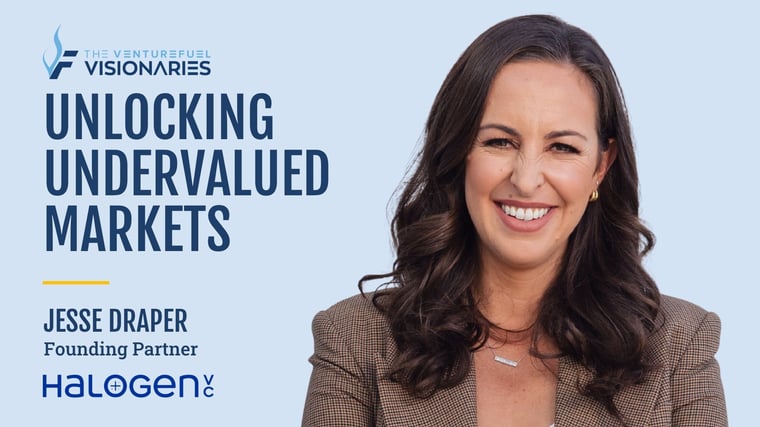
This week's VentureFuel Visionary is Jesse Draper, the Founding Partner of Halogen Ventures, a Los Angeles–based VC firm investing in early-stage consumer and B2B startups led by female and co-ed teams. A fourth-generation venture capitalist and the first solo female GP in LA, she has backed more than 100 companies, six of which are now valued at over a billion (unicorns), while building a platform focused on uncovering overlooked opportunities.
In this episode, we dive into how Jesse identifies signals in the noise when evaluating startups, what sets breakout founders apart, and why she sees opportunity in non-obvious places. She also breaks down her perspective on solo founders versus co-founding teams, the importance of solving real problems in differentiated ways, and how investors can better recognize value where others aren’t looking.
Episode Highlights
- Investing in Overlooked Markets – Jesse explains that some of the best opportunities are often ignored by mainstream investors, whether that means backing female founders or looking beyond traditional startup hubs.
- Founder Traits That Matter Most – She highlights trust, optimism, adaptability, and tenacity as key signals in early-stage founders. Strong founders stay open to feedback, adjust when needed, and keep moving through uncertainty.
- Why Fundraising Isn’t Winning – The conversation makes clear that raising capital is not the finish line. Real success comes from building a sustainable business model, solving real problems, and executing after the money is raised.
- Building Better Investor-Founder Relationships – Jesse stresses that aligned expectations and clear communication are critical after an investment is made. Regular updates, transparency, and support systems can strongly influence startup performance.
- The Power of Emerging Ecosystems – She also shares why regions outside Silicon Valley can be strong startup markets. Lower costs, available talent, and growing local resources can help founders scale faster and more efficiently.
Click here to read the episode transcript
Fred Schonenberg
Hello everyone and welcome to the VentureFuel Visionaries. I'm your host Fred Schonenberg. I am so excited today to welcome Jesse Draper. Jesse is the founding partner of Halogen Ventures, an LA-based venture capital firm that's investing in early stage consumer tech and B2B startups led by female and co-ed teams.
She is a fourth generation venture capitalist and first solo female GP in Los Angeles. She has backed more than a hundred companies ranging from Babylist to Third Love, Trust & Will, Metropolis, and The Flex Company, and several of those of her portfolio have reached unicorn status. So beyond investing, Jesse is a leading voice for gender equity in venture capital, something we've talked about many times on the show, and is sparked in part by her widely shared essay, Investing in Women Isn't a F-ing Charity, which is awesome.
She began her career hosting the Emmy-nominated tech talk show, The Valley Girl Show, and today is a frequent commentator on networks like Bloomberg, CNBC, CNN, while also supporting the next generation of investors through initiatives like the Halogen Fellowship in venture capital. Jesse, welcome to the show.
Jesse Draper
Thank you so much, Fred, and thank you for the kind intro.
Fred Schonenberg
Of course. We were just joking before we hit record that we've known each other on LinkedIn for almost a decade, and this is the first time we've actually seen each other face-to-face. So it is nice to put a face with all the online back and forth.
Jesse Draper
Totally. I'm so happy to be here. You run a nice show. I hope everyone listens.
Fred Schonenberg
Awesome. I love it. Well, so I did a brief intro, but maybe could you give us a little bit more about your background, why you launched Halogen, and the mission behind the fund?
Jesse Draper
Well, I'm Jessie Draper. I run Halogen Ventures. As you kindly stated, we invest in early-stage, female-founded consumer tech and strategic B2B technologies. Our most recent fund was focused on the future of the family. So how do you support the family at work, at home, the physical health of the family, and the financial health of the family? And I got started. It's a very convoluted track, even though you mentioned that I'm a fourth-generation venture capitalist.
While I am a fourth-generation venture capitalist, I'm the first female, and I didn't think it was an industry I could go into, even though it was all I knew growing up in Silicon Valley. And so what I did is, like any young girl, I went to Hollywood, and I became an actress. I was on a Nickelodeon show. I did okay. But if I can bring you all back to 2008, before video content was everywhere, I realized I'd be kind of waiting for these cattle calls. There were 500 great women in the room auditioning. They were probably much more talented than I was.
I simultaneously, because I was on this Nickelodeon show, was invited to, I think, the first Twitter conference at the Skirball Center in 2008, because I was like a Z-list celebrity on a Nickelodeon show. So I went to this Twitter conference, and I thought, this is really interesting, new social media technology. Something cool is going on here. I always had my dad, I guess, in the back of my head saying, how are you going to make this a business, this acting thing? I created one of the first tech talk shows way back when. I know it was one of the first, because I had Elon Musk on, and Eric Schmidt, and all these incredible entrepreneurs, and operators, and nobody cared. And it was like a Borat-style, ridiculous talk show. I can't believe they agreed to be on. It was all pink. And then we started doing deals with Forbes, and Mashable, and all these tech news sites, took the show to TV, were nominated for an Emmy, and through that kind of built out this like tech news blog.
Simultaneously, I was only interviewing men in technology. And I love men, so don't get me wrong, this is not a man-hating club. Joke's on me, because I invest in women, and I have three little boys. But I think this next generation of men, and it sounds like you're helping cultivate them by speaking so often about gender equality. Back then, I made an initiative to interview 50% women in tech, and they came.
Today, we still call that the Batwoman signal. I just got inundated with pitches from women in technology that I didn't know existed. So we started interviewing 50% women in tech on the show. And sometimes I'd say, you're too early. I love what you're doing. Can I negotiate some sweat equity, and get you media exposure? Can I write you a $1,000 check? I created a nice little track record. One of those, I sold for a 26X multiple on the secondary market when Benchmark came in and marked up one of my deals. And then I had a track record. I went and I pitched 500 potential investors, closed 85 for my first fund of $10.4 million. And today, we have almost $100 million AUM, three funds, and we just announced that we made our 100th investment in a female-founded business. And as you mentioned, six are valued at over a billion to date.
Fred Schonenberg
That's amazing. I love the journey. I laughed with the three boys. We have a six-year-old, and my wife is raising a feminist, a six-year-old without question. And it is so awesome. But yes, that is a good-natured joke, right?
Jesse Draper
Yes. Oh, my God. We have those Berenstain Bears books. I love those. My son came back one time with one of these Berenstain Bears books, and it was called No Girls Allowed. He was probably six or something. And he's like, Mom, this is so mean, right? And I was like, my job here is done. My job here is done.
Fred Schonenberg
It is complete. He's ready for the world. I love this. I love the sort of organic nature of this, right? That they were early, and they're like, oh, can I get you exposure, sweat equity? Then all of a sudden, you have the track record. And then you start to build. Can you talk a little bit about... You were talking about sort of some of the due diligence you were doing. What are the key signals you're looking for from these amazing founders that distinguishes them from the noise, right? It's so easy to launch a business now. It's very hard to execute. But I'm curious if there's anything that you look for in particular that is breaking through.
Jesse Draper
So over the last 10 years, our model has changed so significantly being early stage investors. And you can't do anything alone. I have two partners. I look for very different things, and some of the same from fund one. Now being in fund three and also having so many lessons, and you really learn those lessons early on. I'd say the one thing we've really stuck with is the people. This is a trust-based human interaction business. And at the earliest stages, you can only do so much diligence. Today, you can check out their social media and all of these things.
But we still now say, especially post-COVID, great. We had you on our pitch day. We do these 30-minute pitch days where we'll take 12 pitches. This is interesting enough. We'd like to move forward. And you get to meet one of us. We're on the East Coast, West Coast, Miami, wherever you want to find us. We need to high-five you, make sure you're real, and evoke that people-reading energy because we feel we miss things when you don't have that human trust interaction.
The other piece is just insane optimism, openness to pivot. We ask a lot of questions up front about how they would deal with things like international pandemics or if their manufacturing plant was burnt down. We like to hear what they're going to do to evolve their business. And if they're open, if they're the kind of founder who's like, no, this is how it's going to go. Nothing's going to be out of whack. It's straight up. Those are the worst founders, honestly, ever. They're just the worst. They think they know everything. I don't know everything. You don't know everything. We can each learn from each other and everyone out there listening. I can learn from all of you too.
And so you want a founder who feels that, who can take in all of the data points and then decide what direction their business should go based on the feedback and isn't thinking they're the smartest person in the room. Then if you want more real tactical data points, we look for some kind of traction. It could be a hundred thousand users. It could just be some kind of study showing me there's a need for this opportunity. We look for something proprietary. How can you defend this product that you're building and own it and no one else can do it? And why are you the best to do it?
And then ultimately, I mean, I'm much more focused on this than I was in the beginning because early stage investing, there are those deals that come to you and they haven't made their first dollar. I just need to know. I don't care if you've only made $1 or $2. I need to know how you're going to make that because way back when in 2017, there were these tinker founders who were like, well, I haven't figured it out, but we will figure it out because it's unique technology. I don't bet on that anymore. I'm like, great, cool. Call me when you have a business model.
So those are a couple of the things I look for, but really it's about the founder first and foremost. I'm sure you speak to, a lot of people ask things like, are you okay with co-founders? Are you okay with solo founders? And I'm probably one of the only people I've heard say, I love solo founders because the experience I've had, many, many experiences with co-founders, one always falls off. So you need one who has the vision and direction to take the ship all the way. And I'm fine with both, but I need to know someone's leading this thing forever as an investor. So we're open. We really just want to work with great people.
Fred Schonenberg
I love that. There's so many gems there. I also love solo founders. I love solo founders that realize they need a very quick number two to do the operation side, but that they have the vision and they're ready to pivot. And when you were talking, it reminded me of my first startup in 1999, maybe 2000. At that point, there was software that helped you write pitch decks. This is how old I am. And it spit out a 62 page pitch deck with seven years of financial models, and the degree to which that was wrong, the second I hit end on what the business was.
It was like, everything I thought was going to happen, none of that happened, but the idea was good. And it was like, we just pivoted left and right. I mean, luckily things have changed since then that it's a little less, tell me what seven years looks like and a little bit more of the founder.
Jesse Draper
Oh, totally. It's such a good point. It's such a good point because it never goes straight up the mountain. It's up and down. I just got off the phone with one of our founders and I believe in them. You also have to decide who you believe in wholeheartedly. We sort of have this philosophy that we know it used to take two years. Now I'd say we can tell in seven to nine months if we're going to double down on you. And it's all based on such basic behavior.
It's like, do you communicate quarterly? These data points we have on our 100 plus founders now are so basic, but we actually call in our founders now two weeks within investment. We say, hi, we're here to set expectations. We expect you based on our portfolio data to communicate with us every quarter, because we've learned that the eight portfolio companies who didn't, did not perform as well. Also, do you have a CFO? If you don't, we've also learned that we need to put a fractional CFO in at the earliest stages and you will perform better.
So we actually now come in and support them all around because you can't expect someone to know everything, you know, at those early stages. And a lot of people don't know how to communicate with their investors. And so we've also learned… especially these first time founders, you know, and so we'll kind of set these expectations. We have a whole packet, we walk them through. We have this great operators network from, with operators who are under NDA with our portfolio for two years from Walmart, all the way to Apple, who are there to support them. That's one of the ways that I think our portfolio structure has changed over the last three funds and what I've learned from fund one and those losses, because you have to lose money to make money in VC, which I think is something not everybody knows. We haven't lost money for our investors, but we do lose deals. And which is why it's a diversified portfolio.
You need to give them so many resources at the earliest stages. So we think, at nine months, we'll decide if we're doubling down on you. And that has been really interesting. But this founder I was speaking to, we've already decided we're going to double down on her. She's incredible. This is an amazing business, but they're having trouble fundraising as some do. And so we're kind of evolving as her round evolves. We're like, sure, we'll leave. No, we don't have to leave. We're just in it. We know this is a company worth betting on. We're going to continue to bet on it, but it never goes straight up the mountain. I wish it did. Actually, it wouldn't be the journey.
Fred Schonenberg
It wouldn't be fun. It wouldn't be interesting. It's, it's definitely, it's supposed to be this way, right? There's supposed to be bumps in the road to make it interesting. I think one of the things you mentioned about sort of the power law, the idea that you need to lose some deals in order to find the winners.
We work a lot with large enterprises and kind of marry them with startups and sort of for that commercial validation and scale up moment. And oftentimes I'll talk to a CEO of a publicly traded company. I'm like, yeah, listen, you need to have 10, 10 to a hundred, depending on how big and what your aspirations are. And one of them is going to succeed really big and that's going to carry your version of the fund. And that idea sounds so nice until they start to see the first seven fall off, and I'm like, no, no, that's part of the game. Like you're good. The three that are at the end are the ones that are going to be the most interesting. And it's just, there's a certain mentality that needs to be there in order to kind of weather that reality.
Jesse Draper
I completely believe that like through and through. I say the same thing to anyone who says, I want to get into angel investing. And I'm like, okay, you're going to lose money on the first deal. So you've got to do 10. So whatever capital you're planning on angel investing, break it into 10. I don't care if it's $1,000 or $500, break it into 10. You have to sort of think that way because those are the odds.
Fred Schonenberg
All right. So I got, I got to jump into the Medium essay that you wrote. Investing in women isn't an effing charity. It's the first time I've ever had to look up if I'm allowed to swear on our podcast. It's not that podcast and I swear all the time. So I love the title. We've had Sally Krawcheck on the show, Sallie Krawcheck. We've had Caroline Lewis who runs Rogue Women Ventures and a number of other folks. And I just… the title of that is part of the ethos of everybody that we've had on talking about this subject, which is like, Hey, this is good business. Like women make great founders. The data is there. Why does this have to impact investing? Like that's not what this is. This is financial. And yes, there's an upside on the impact, but this is about business. I am really curious what sparked you to write it and how you feel that conversation has evolved.
Jesse Draper
You know, I wrote it just after my first fund. I was fundraising for my second fund and I was… you start to see the patterns after hundreds and hundreds of pitches of your fund. And we were investing in female founded businesses. We have great deal flow. That was an opportunity that we still call, I was saying the bat woman signal, like women are looking for female investors as well, and we're still inundated. And it was a deal flow opportunity. Plus women are starting great businesses and I shouldn't have to defend that.
But I think it came out of a real moment of frustration. I was so sick of people saying, oh yeah, it's like charity. It's like charity. Like we could invest in this like charity. I'm like, well, you can invest with your foundation. It is not actually charity. We are investing in for-profit businesses that will be self-sustaining. And I got very frustrated that I'd meet with all of these women philanthropists who tend to be the women who kind of put themselves out there and have large amounts of capital. And I got really frustrated in meeting with all of them saying it was like charity.
And I'd have to have six or seven meetings explaining to these female philanthropists what venture capital is, which is fine to educate. I think that's a whole part of what we do, but they would say, oh, well, I just gave 3 million to this charity. And I'd be like, well, you could write that to a venture fund as well. They just felt more comfortable giving away their money. And it was very frustrating while I had a lot of men come at it that way too. They're much more comfortable. I'm speaking to you. It's always dangerous when there's one man in the room because it's like that man represents all of mankind.
Fred Schonenberg
Not all of them. I'll take the hit.
Jesse Draper
There's a few, but I think when I look at the difference, cause I see a lot of this, like I see through this gender lens very specifically now because we invest and make sure there's a female in the founding team. We have a hundred deals and seven male CEOs. So again, we love men. But men have this, they do kind of a gut check, they take the risk and they feel comfortable taking the risk much more so than women. Women are super risk averse, and because of that actually making credible investors. They bring a lot more data points in, and this is all very data driven research, but they have a lot more data points to take in.
So we need men and women in the room because the men will make the women feel more comfortable taking the risk and the women will bring up the questions that need to be brought up. That said, we are in a risk-taking business. You have to have some capabilities to take risks, but that was very frustrating for me. This charity article, I think, sparked something. And when I look back after fund one, I pitched so many people. And so many men and some women would say, this isn't an opportunity. Not enough women are starting businesses. This is a horrible idea for a fund. I mean, some of those meetings, I wish I could just erase. They were so discouraging and I can't believe I'm still doing this. It shows how crazy I am.
And now it's really been a reflection to look at our portfolio. Honestly, I'm a competitor, so I look at their portfolios and none of them have unicorns in their portfolio, but we do. And so I'm really proud to be like some of those companies that they didn't believe in are valued at over a billion dollars to be going public next year.
I think it's sparked something that I never anticipated. It clearly hit a nerve for a lot of women in business. It went viral, it got like a million reads or views or impressions or whatever, almost overnight. I was kind of blown away. And it put me on this other sort of speaking tour trajectory I never anticipated. Just because I was expressing a frustration that I had seen based on all these meetings I had had. And unfortunately, the numbers haven't changed too significantly, but they are changing. I do believe they're changing and different conversations are happening. And there's incredible men like you putting people like me out there to talk about it.
Fred Schonenberg
I think one of the things that's really unique, and maybe I'm connecting dots here. So tell me if I'm wrong. But it seems like you've established a real niche with the ability to pinpoint undervalued startup ecosystems. And I'll kind of compare the work which we can talk to that you're doing in Alabama, to this where certainly it was a little bit organic to begin with, that you were starting saying, Hey, wait, how come that's all men on my show? Let me make sure to diversify this. And then wow, there's lots of big business opportunities there, who's investing in you, you start to see that, then you start to see the unicorns.
Now you kind of see that in places that aren't Silicon Valley, right, this idea of Alabama or somewhere not on the coasts as a potential for startup businesses. Can you talk to me a little bit about what the Alabama opportunity is, how that came to be? And then what drew you to that?
Jesse Draper
I love how you're connecting these dots and making my life make sense, which didn't make any sense directionally. But I appreciate that and may steal that and use it because it makes sense. But I do think about that a little bit. So just, you know, to Fred's point, what we're speaking about is I over this last fund, really, what happened was fundraising is really hard. This last fundraise cycle was a lot of funds actually, and we were looking under every bedspread for capital, we pitched as many people, we had already brought in our past investors, and we were looking to really break into new institutions.
So we went after this thing called SSBCI capital, which a few states offer each state receives this funding, and some choose to put it towards a fund of funds, not all just a handful of them. We pitched Alabama, my team had put together a great package for Alabama. And actually, a lot of our companies were already servicing Alabama. Our company, Upwards, is the largest childcare network across the country of in-home vetted childcare locations for affordable childcare at 1000s of locations across Alabama. Metropolis, our parking company, had many locations, hundreds of locations across Alabama. And so we did have business there already. And we were looking to kind of build that out for them.
What I didn't totally understand was, when we took the funding, I understood it, obviously going through the paperwork, it was, we were going to be investing in Alabama primarily. We made it a little bit more flexible, created an entire fund dedicated to investing in startups in Alabama. Now, as someone who looks for the newest, hottest, most exciting technologies you've literally never heard of, typically in Silicon Valley, LA, New York. But we always had companies across the country at this point when we were looking at Alabama funding. We had one in Kentucky, many in Texas and things.
And simultaneously, to connect your dots, I always was saying, can we shine a light on where all of the capital is going? But to bring it back, you know, I was looking at it, how do we democratize this funding? Because the majority of the advisors are mostly located in New England territories, they manage billions and billions of dollars of the world's capital. And it all goes to the same five funds in Silicon Valley, who I love, who I work with, but what would happen if you blew that up and dispersed it across the country, who wasn't getting any of this, you know, tech money, if you will, and innovation and technology, there's still great resources there.
So we looked at Alabama and thought, can we do this? I don't know. I mean, we really made a kill switch on the money, because we didn't know that much about Alabama. Here's the thing, I am very competitive, and I love a challenge. Alabama is ranked 50th for female founders. That got me and I was like, well, there's only one way to go. Let's see if we can do this. We were the first out of state fund to receive funding from the state of Alabama. And none of us had been there before. So we knew that we needed to go and listen and see if there were founders that were worth investing in.
And I am telling you, you have spent some time in Birmingham, as you mentioned, it is the most incredible ecosystem, and so many things happened that I didn't anticipate. First, just to like, touch on the ecosystem of what you can build there. There's a huge university system.
University of Alabama has three campuses, hospital systems, you have Auburn University, you have 50 Fortune 500 companies represented to be based there. I've now been to six cities across the state of Alabama, from Dothan to Montgomery, to Birmingham to Huntsville to Tuscaloosa to Mobile, my favorite place, it's so beautiful. And I've met with all the accelerators I can. There's great aerospace, you know, the United States Space Headquarters is moving to Huntsville. There's software ag tech, like I just saw some really crazy cool plant technologies on my most recent trip. And, there's water. A lot of the country can't say that right now.
Huge opportunities there and great companies were already being built because Condoleezza Rice had paired up with Stanford University five years prior in 2020 to do a big study on how to innovate Alabama. So we actually came five years into this program. You can Google it. It's a 150 page study, but I still think you need to go there and live it. And I started talking to the founders, seeing a couple of the unicorn companies that had already come out of there when we got there. And I just thought, oh my God, this is such an opportunity that people are not seeing at all. I'm so excited.
What I didn't anticipate, and we've already done nine deals and we're doing, we're in the process of doing six more in Alabama alone. What I didn't anticipate is that my 80 plus other businesses would start calling me and saying, how do I do work in Alabama? Or my best-selling Sephora is in Birmingham, Alabama, or we were looking at Alabama for manufacturing our EV charger products. Who should I talk to? And within the first couple of months, we had 10 of our portfolio reach out and we started actually doing more economic development than I had signed up for, to be completely honest. We're meeting with the treasurer of Alabama. I just got back and I had said, okay, so all these, I'm trying to bring work to Alabama, which will benefit all of us. And I'm not sure who to plug them into. I send them to you, this admins, I send them to you. So we're going to put together a formal committee to figure out where they can work.
And it's like problem solving, and it's been so rewarding. Every dollar there goes so much farther. I recommend all corporate companies listening, all anyone listening, hire in Alabama. There are brilliant people. There are great companies. I mean, we've invested now in a drone company that does security and works with law enforcement to literally solve crimes and provide security for things like the World Cup, all the way to a childcare company. And what I'd say about our tech enabled childcare, we have the same business in Los Angeles, California. We have four locations currently in our Los Angeles tech enabled childcare facilities. It took eight years to get all four of those up and running. Each costs $2 million to get up and running. DCFS was a nightmare. And it's been very, they're profitable. They're doing incredibly well. It just takes longer to get these up and running.
In Alabama, we have two profitable locations already up and running in seven months due to less regulation. And so it's an opportunity. Walmart's the largest employer in the state. Mercedes is up there too. They have the head of US manufacturing. I mean, I could talk about Alabama all day. I don't want to bore you, but I'm telling you, come work in Alabama. We love it. I've been nine times in the last year. It's an incredible opportunity and explore. Don't just go to Birmingham and Huntsville. I mean, we saw some great stuff in Dothan last week.
Fred Schonenberg
Yeah, no doubt. So, I mean, we talked a little bit before we hit record. I don't think I've ever talked about it on the show before, but I spent seven years in Alabama before college, moved down there when I was nine years old and kind of went down with, I don't know anybody, I don't know what this is, and really established some amazing lifelong relationships. And I saw a lot of what you're describing about the opportunity there, the intelligence of the folks there, and it is a ripe place for startups to build and grow. I went to Space Camp in Huntsville for the record. That's another story for another day.
But I think that what you're doing there is really important, but I think that it is one of those places where once you spend a little time, you go, oh my gosh, like this has the makings of something really transformational and what they need is bringing in innovation. So I love how you've thought about this. And obviously that has big economic development opportunities. But I think to your point about it not being charity, there's big upside there. And I think Shyft, if I'm not mistaken, came through before Target.
Jesse Draper
He was one of the first founders I met with. He sold to Target for 550 million in 2017. And I sat him down and he's like, you have 30 minutes. I was like, okay, cool. How did you hire in Alabama? How did you retain talent? I had this whole list of questions. Another one is this guy, Shegun Otulana. He started Therapy Brands, which is now worth $1.3 billion. And I meet with him every time I go. KKR just bought a huge stake in their company. It was a software for mental health services. And there's so many.
I was having this moment recently of, okay, well, where's the female founder billionaires here? I know there's some. And I look at the cover of Forbes, no joke, like a month ago. And it's this woman, Tricia Wallwork, who started Milo's Tea, based in Alabama, a $1.7 billion tea business. I cold outreached her on LinkedIn and was like, I'm coming to Alabama. I would like to host a brunch for you and I would like you to speak to how you did this. She's incredible and a huge mover and shaker in Alabama. I just feel like it's, yeah, people, I think what I'd like to say too, is people have a lot of preconceived notions. I certainly did coming from California.
Unfortunately, I think the press does something weird where they are, it's like us versus them constantly. Nothing I have done has been political other than working with politicians who have been elected to make change and they move fast there. And we got red, we got blue, we got purple. I mean, it's like, I don't think that… you need to go meet the people and visit the places before you come up with those preconceived notions. And I'm really speaking to myself because I've been blown away.
Fred Schonenberg
Yeah, of course. And Milo's Tea, I'll never forget, I brought a group of my New York friends down to go to a football game there. And we went to a Milo's and they said, would you like some sweet tea? So, and my friends were like, what, what? I don't understand that. I was like, it's sweet tea. And then they took it, they're like, oh my God, this is sweet tea, I'm like, it's good, right? They were like, they drank it all weekend.
Jesse Draper
Did you go to a lot of waffle houses? I just ate at a waffle house the other day.
Fred Schonenberg
Oh yeah, all the hits.
Jesse Draper
Blueberry is my favorite.
Fred Schonenberg
Oh my gosh, it's great. Yeah, the first weekend I was ever in Alabama, I was asked the question, who's your team? And I thought I was a nine-year-old boy. I was like, oh, the Yankees. I was from New York. They're like, no, no, no, no, college football team. And I won't answer nor make you answer that question. But my stepfather who went to law school at Alabama said, there's only two right answers. And for you, there's only one right answer. So it's true, that part was true. It's a little bit of a religion down there with football, but…
Jesse Draper
It really is. He hosted a pitch competition actually at the stadium. And I mean, what an experience, I have to say. Really, incredible, incredible thing. But I love that you went to high school there.
Fred Schonenberg
Oh my gosh. I got good stories for you for another time, but let me do this. I'm gonna get you out of here on this. You've got important investments to make. We do like a rapid fire at the end of the show. And one of the things we talk about with our corporate partners is like, we help them commercialize what's next, now. So I think about this like, what's next, now? How can we bring the future today? So that's the sort of theme for our rapid fire. So I'm just gonna hit you with like four or five quick questions. Just want your gut instinct answers.
Jesse Draper
I’m ready.
Fred Schonenberg
All right. So what misconceptions about venture capital should just disappear?
Jesse Draper
That you make money immediately.
Fred Schonenberg
Yeah, no doubt. What's the biggest mistake founders make when pitching investors?
Jesse Draper
Apologizing.
Fred Schonenberg
What is one piece of advice you would give a female founder that is going out to raise capital?
Jesse Draper
I would say this to any founder, male or female, just get out there. Your 2.0 is always gonna be better than your 1.0. Don't wait till it's done. Just throw paint against a wall and get out there.
Fred Schonenberg
I love it. What tech trend is underestimated right now?
Jesse Draper
So many data centers. I mean, that's what I'm like all about right now.
Fred Schonenberg
Are there any founder traits that you don't think can be taught or learned?
Jesse Draper
Tenacity.
Fred Schonenberg
I like that so much better than grit. It's the same vibe, but there's something to it. When do you trust your instincts over the data when investing?
Jesse Draper
Always.
Fred Schonenberg
If you think you're the best pitch you've ever seen, can you pinpoint what about it made it stand out?
Jesse Draper
They're solving a problem that had never been solved before in this way. And I think it's something that can be replicated in many industries.
Fred Schonenberg
Man, I love it. The whole reason I got into this was, this is a ridiculous story to tell right now, but it's about new solutions. I remember my grandmother. I was doing a project, like cutting up cardboard, and I couldn't figure it out. And I was frustrated. I was probably five years old. And it was one of my first memories. And she was like, there's always a way. She turned the whole table mat around and she's like, you just have to look at it differently. For some reason that stuck with me. And I think that's what gives me so much energy when I hear a founder look at a problem slightly differently and be like, hey, this is how you solve it. There's just such energy in that.
Jesse Draper
Totally. I agree.
Fred Schonenberg
All right. So if not venture capital, what career would you have done besides Z-list celebrity on Nickelodeon?
Jesse Draper
Marine biology, because I have an obsessive fear of sharks. I want to be with them and I do these open water swims. But I also have all my devices that apparently quote unquote, keep away sharks. And I have three shark apps. I track them. One, I pay for monthly. It's ridiculous. So marine biology. I could get past this.
Fred Schonenberg
Sorry. Very New York moment. A helicopter is going over the recording studio. You know, what's amazing is I went cage diving with great whites in South Africa. I remember being obsessed with sharks my whole life and then seeing it in the water. And I was like, oh, my God, that is a school bus that moves like a Ferrari. And there's nothing I can do if that thing decides to eat me. And I'd like to get out of the water.
Jesse Draper
That's how I'm going to die, Fred. Like that's like my all my friends, my family. They're like, oh, well, it's OK if we're in the water with Jesse. It's how she's going to die. So she'll die and we'll be OK. We just need to bring Jesse into the water. It's so I'm just that's how I'm going to die. But I'm ready for it. And you know what? I love a good swim in the ocean.
Fred Schonenberg
I think the best part about this is my thought is like, oh, that means everyone's going to invite you to go to the beach with them. So like there's an upside.
Jesse Draper
No, the upside is they’ll live.
Fred Schonenberg
Yeah. Well, for them, there's a whole different set of upsides why they should invite you. Jesse, thank you so much for making the time for everything you're doing to spark change. It's really awesome. Where should people go to learn more about your work?
Jesse Draper
You can find me on Instagram @jessecdraper or @halogenvc. We're pretty accessible. We're looking for pitches all across the country. You can also fill out a form on our website, halogenvc.com. But you can find us on LinkedIn, on all the social mediums. And we try to be as accessible as possible.
Fred Schonenberg
Awesome. Well, thank you very much.
Jesse Draper
Thank you, Fred.
VentureFuel builds and accelerates innovation programs for industry leaders by helping them unlock the power of External Innovation via startup collaborations.