

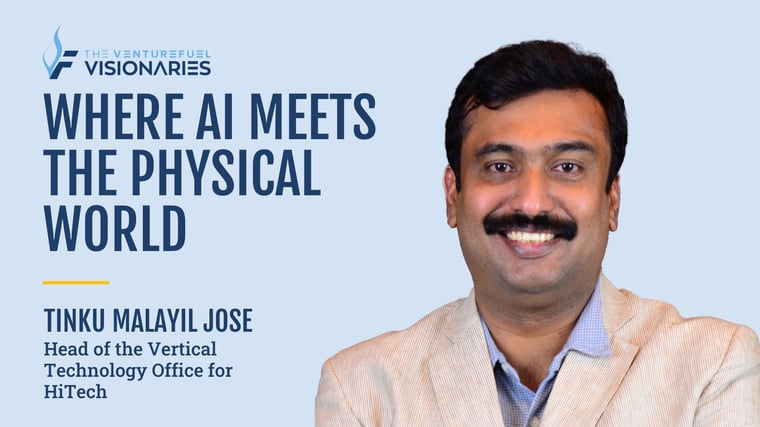
Where AI Meets the Physical World — Quest Global’s Tinku Malayil Jose
Published by VentureFuel Team on
May 6, 2026 10:34:45 AM
AI is no longer confined to software dashboards and chat interfaces, it is increasingly embedded into physical products, devices, and systems. What changes when intelligence moves from the cloud into real-world hardware?
This week's VentureFuel Visionary is Tinku Malayil Jose, Head of the Vertical Technology Office for HiTech at Quest Global. He has more than 20 years of experience building complex products, from smart TVs and streaming platforms to automotive systems and IoT. He also operates at the intersection of silicon, software, and real-world application.
In this episode, we ask Tinku to break down the shift from AI hype to reality, explaining why the future of AI isn’t just software, it’s embedded in physical products, devices, and systems. He also shares what’s driving the rise of “AI appliances” and why purpose-built, domain-specific solutions are increasingly outperforming general-purpose approaches.
Episode Highlights
- Turning AI Into Real Products – Tinku shares how success with AI is not about building better models, but about converting them into scalable, reliable products that work under real-world constraints like latency, power, and usability.
- The Shift to Physical AI – He explores how AI is moving beyond software into embedded systems, powering devices, vehicles, and industrial environments where intelligence operates directly at the edge.
- Why Purpose-Built Systems Win – Tinku also explains why smaller, domain-specific AI solutions are outperforming general-purpose models, especially when designed around clear use cases and operational needs.
- Breaking Out of Pilot Mode – He outlines why many companies stall at experimentation, and how shifting mindset, ownership, and workflows is key to scaling AI across the business.
- Startups + Enterprises = Scalable Innovation – The conversation highlights how startups act as focused problem-solvers while enterprises provide scale, making collaboration between the two critical to bringing AI solutions into production.
Click here to read the episode transcript
Fred Schonenberg
Hello everyone, and welcome to the VentureFuel Visionaries podcast. I'm your host, Fred Schonenberg. I'm thrilled today to welcome Tinku Jose. He is the Head of the Vertical Technology Office for HiTech at Quest Global. So Tinku spent over 20 years building complex products from smart TVs and streaming platforms to automotive cockpits, ADAS, and IoT systems, working across the full stack from Silicon to user experience.
Today, we're gonna talk about what it really takes to turn AI and emerging technologies into real-world products and what most large companies get wrong. So please join me in welcoming Tinku. Tinku, thank you so much for being here.
Tinku Malayil Jose
Thank you, Fred. It is actually a pleasure to be in this podcast. Thank you very much for having me.
Fred Schonenberg
Oh, it's our pleasure. And maybe for the people that don't know, can you give a brief introduction to Quest Global and what your focus is there?
Tinku Malayil Jose
Sure. So Quest Global is a design and product engineering services firm. Basically, if you really look at it, we want to try to bridge the gap between the digital dreams, as we call it, with the physical reality. So that pretty much sums it up. And we don't just write code or software just like that. We build machines and devices that run it and also maybe design silicon that powers those devices as well. And as I mentioned, I head the technology office in the high-tech vertical.
My focus is to actually have a pretty wide category from silicon to system to experience and drive technology strategy and productization, basically, to bridge between the R&D and the product, basically. That's what my focus is. To simplify, convert those emerging technologies around into a shippable, validated product which everyone can use.
Fred Schonenberg
Yeah, it's so interesting. It feels like such a gap between what's possible, what people are excited about, and then actually what is scalable, productizable, so it's a very interesting link there. How did you get involved in this space? And can you tell us a little bit more about your background?
Tinku Malayil Jose
Oh, yeah. So I've been in the electronics and IT industry for the past 20 plus years. And I've been leading the business technology leadership, business technical functions. And I'm meaning it is about, while we talk about technology, the architecture of the chip and the product, how it is used, it's also about understanding the end user or empathy for the end user and how to make that technology and the product accessible for users and have a frictionless user experience impact. That has been my passion.
And I like products. I like products for end consumers, whether it is users or it can be enterprises, doesn't matter. So, and I always tell, I believe in the holy trinity of technology, business and people. So basically it all has to come together to actually deliver a great product or help in delivering a great product.
Fred Schonenberg
So one of the things that's interesting is most people when they think AI, they think software. And a lot of pundits, venture capitalists, a lot of people that I kind of follow and talk to are really most excited about this jump of AI embedded into products and hardware, physical AI. Could you talk a little bit about what's becoming possible in that space that maybe wasn't realistic a few years back?
Tinku Malayil Jose
Yeah, I think it's been an interesting breakneck speed evolution of AI in the last couple of years for sure, so it has been shifting. AI is something which is an app to have the capability inside a device or a system and it provides a really good experience for the end user. So now we've been interacting, a lot of people were using a lot of technology, heavy systems or software to interact with. And from there, it became a chatbot.
If you really look at it in the last couple of years, chatbot has been the main, main trend. Now, I would like to call myself focusing more on the AI that lives inside your devices, the mobile or your car or the wearables. That's actually a big thing which is happening. So I would say that it is more of a physical AI, not from a robotics perspective, but the AI that lives inside the device delivering what you are looking for.
And with that, comes a lot of challenges. If you look at it, you can talk about thermal and power problems. It's not easy, the latency problem, the user experience or the complete life cycle. So at the end of the day, it is gone beyond for me from a device perspective, gone beyond the model accuracy and all of those. It is actually getting into seamless experience of how we will be able to make the technology invisible for what the user wants, or even for that matter, how to democratize the AI. So when you want to democratize AI so that everyone can use it, everyone will not be able to use chatbots in a laptop or a mobile. It has to just be accessible for someone who is not even aware of how to use some of these chatbots and all of those.
That's something which is driving from a perspective from a software, just a software to hardware. And it can be multi-model, using multi-model images or voice or gestures, or even recently I've been reading a lot about BMI, the brain machine interface and how it actually is. So these are the things which are making it just from a software to beyond software to deliver that experience, Fred.
Fred Schonenberg
Yeah, you said a bunch of really interesting things there. The idea of the technology becoming invisible and people not thinking about it, but benefiting from it is such an interesting next step. As well as this idea of sort of like AI, I know you've talked about this before, AI appliances, this idea of preconfigured, maybe purpose-built systems. Can you talk about that a little bit?
Tinku Malayil Jose
That's right. I think, you know, we've been listening and we've been hearing a lot of general purpose servers, a general purpose that's what the market was saying. If anyone wants to get a server, you need to get a general purpose server. And, you just configure the way you want or, and all of those, in fact, those were the days, in fact.
Now, if you really look at, for example, I want to actually have a robot installed in my enterprise, in my factory that will sort the bits, just to give an example. So I should not be looking at a general purpose LLM and I should not be looking at something which is really a large system just for doing that. And maybe I'll be using only 30% of what's really required. And in some places, I'm actually having problems in capacity because it may be that the processing in the GPU is needed more.
It has to be those devices or those appliances that have to be built for that specific physics or the specific activity we are calling it. So we should be looking at use cases and challenges defining the system rather than systems designing what you have to do. That is what we can call as purpose-built systems or pre-configured purpose-built systems.
Fred Schonenberg
Yeah. I think it's so interesting, right? This idea of large language models being the solution for everything and people are realizing, no, it's actually maybe it's small language models or on the edge or as you're saying purpose-built for a small specific thing. And then obviously you can connect it later from more of an agentic standpoint should you need to.
Let me ask you this… obviously it's harder to scale when you're talking about smaller groups. So can you talk about what you think separates the companies that will actually be able to scale these AI products versus those that will merely be running small pilots that don't necessarily generate the type of impact that people would hope for?
Tinku Malayil Jose
Very interesting. So this is something which I've made a lot of customers in, that's part of my role. And I will see two kinds of customers right now. I would like to categorize. Some of them are doing pioneer work in AI. So, and some of them are actually doing, they're leveraging AI, but maybe I don't know whether they are still trying to figure out what ROI is so this is the way it is. But I feel that it has nothing to do with technology. Like if technology is accessible for everyone, that's the way it is.
It is about the mindset and the thinking, which is most important. It is about, and I would say that a focus on enablement, it's not just tools, it's more important. And also I've seen the leadership, how they are or their behaviors about AI. That is what is really, really differentiating. If we try to think of AI as a tool, which can just be tied to an existing process to make it a little bit better, then you are gonna get stuck in pilot. I don't think we are gonna move. It is about more of, you know, how we can try to embed these AI capabilities into our current workflows and then make it work, right? Get work done faster, better. That is where companies are actually scaling AI in fact.
And one more important thing which I haven't seen is that the moment we have companies or enterprises driving AI by innovation or a strategy team, that has to be relived. Because until all of that is a business owner driving that, you know, there is a benefit of what's needed. Then that is the right track. It has to be business ownership for that. But that's what I meant by going to not be, it should be, we should think beyond technology. It has to be looked at that's why I feel the biggest differences in fact.
Fred Schonenberg
Tinku, let me ask you this, cause there's a tension there that I think is really interesting, which is there has to be a business problem to solve, a business owner that cares about this becoming faster, better, different. Because then it's real, right? It's not technology for technology's sake.
However, when you have just that business, you know, focusing on that small thing, you also tend to get into incremental change where it is so specific that you don't see that sort of, that seismic transformation, right? That unlock of something bigger. How do you balance that specific business problem versus maybe the potential of AI to transform the organization?
Tinku Malayil Jose
That's actually a pretty, pretty good question. So when I say that we have to start looking at the use cases and business model. When we look from a perspective of the leadership or the business owners, what they're looking at is not just trying to solve that one problem.
If you're looking at a small group inside a company trying to do that, it will still get stuck into that middle one. So as I mentioned earlier, this is a mindset change as well as a leadership behavior change in fact. When I talk about business owners, this is not the business owner of a particular group. It has to be a little bit, it has to come from top down while a lot of activity has to happen from bottoms up also.
Now, it should not be just enabling tools where say the engineers were working on it or creating some chatbots or co-pilot for helping them do something. That's not the way it is. It has to be something which has to be looked at a little bit broader. Now, as you mentioned, you can get into very siloed multiple operations, siloed multiple POCs or different groups trying to solve the same thing with different tools and technologies that can happen.
But all of those are, in my view, good things that's happening because we are actually creating different approaches to solve the problem. And at some point, when we look at it from the top down, we will be able to see, okay, what is the best way? Can we have different approaches to solve the same problem and maybe let the users or let whoever is gonna use it define what they want or decide which one to use in fact.
That I would go back to the cloud example. You have a lot of cloud providers. I'm not gonna name any, but you have a lot of cloud providers and at some point, everyone used to get hooked up with one of the providers instead of the other one and one of those. At some point, they all have to come to a common platform and say that, yeah, I would like to use X from provider A, Y from provider B, because that's the best way to do it. And hence, I want to actually have everything together.
That redesign, re-architecting was not easy. So I think we should learn from that. I will not be worried about trying to go down the path of, okay, we have to have a uniform solution right now. Instead, it's evolving and a lot of open source things are coming up. Let's play around with everything, but the mindset is to adopt AI. If that is the case, I'm pretty sure that the organization will figure it out. And as it matures, AI matures, the tools mature, we will adopt the right one. So it is a good tension to have for sure.
Fred Schonenberg
Yeah, it's a great conversation. We see this a lot with large enterprises we work with where there's this tension between centralized control and sort of distributed on the edge business units running pilots. And we have one group where we know the startup really well and they're running almost 10 different pilots with groups within the same company, different business units, different countries, right? And nobody's sharing how it's going. So they're very isolated.
And so they're sort of like an extreme that is dangerous, but I agree with you is letting the users that have the pain point take the initiative. And then it's about figuring out how they can share those results back so that you're not constantly reinventing the wheel. But I love the cloud analogy. I think it's very, very smart.
Tinku Malayil Jose
Just one more point I would like to just add to that is, the moment we try to enforce something, what will happen is that we will find excuses for not using, saying that legal will not allow, compliance is not gonna agree to this, security will not sign up for this. And that will become the bottom line, that will become excuses for not doing it rather than, okay, how I will find a way to actually do it also.
So there was a point of view, which I wrote in this area, how enterprises can actually enable the users or the core is using it, that it can be developers or whoever is using it to try out what they want and then choose what is right for them. At the end of the day, data is very important. So that is something that we will secure, but the tools used, processes used, LLMs used potentially can be any.
Fred Schonenberg
Well, if you share that with me, we'll put it in the show notes cause I think it's a very interesting challenge to solve. So let me ask you this, I know we're tight on time. So I'm curious if you see… you're working with lots of large industrial companies, how are they working with, or how do you think about working with startups in this space, right?
We see a lot with large organizations where they have a build first mentality. And a lot of these AI tools enable people to build faster, better, the replets of the world, right? Where they can go and maybe with a low code, no code solution, come up with something that's pretty interesting. I'm curious how you think of that build versus partner balance and where you're seeing maybe startups being a successful choice.
Tinku Malayil Jose
Oh, I'm going to be very simple in this video. I'll just go very simple with that actually. Startups are like the special forces. I mean, if you take, I don't like to take this example, but that's the easiest way to understand. We take a water battlefield. They're like the special forces. They have… they innovate, they're very niche, and they just try to solve that specific problem and they do it efficiently, effectively, and they will be able to adopt and adapt very fast. That's the way it is.
Whereas the large industries, they are pretty important as well because they provide the battlefield. They provide the theater and the scale and the environment which is really needed for these startups to work in fact.
So the partnership is very critical there. And the startups need to be on the tool, innovating and trying to solve a specific problem and then get into other partnerships to actually grow and provide solutions addressing not just a focused problem or use case. They should also expand and try to see, okay, how this can help maybe something else. That is important.
For just to give an example, now we have ADAS, which is autonomous driving, which everyone is talking about. That's a technology which is being used. There are a lot of companies focusing on it. But there is a bigger value for the same system in a little bit less riskier environment, like a controlled environment, like a factory floor, where it can have autonomous robots shipping or shipping data, what you call as machinery or whatever, payload from one place to another or a rail, which can actually run by itself, which is, again, a controlled environment.
So someone who is providing a vision-based algorithm for navigation should be ready to take, or should be able to take either work with an automotive company to provide autonomous driving or an industrial robotic company to provide autonomous robots for the floor, shop floor, or maybe a rail company to actually have autonomous rail, trains, basically. So that's the way I would look at it, in fact.
Fred Schonenberg
Yeah, I think the special forces are very interesting. I've heard the analogy before of almost on the water, where you have sort of the big boat that's going across the whole ocean and can handle any weather, and you need to deploy little boats, right, to go out and explore what's up ahead. And they go out, and then they come back and report and say, hey, turn five degrees to the right. Let's go this way. And they do it together, right? So I think it's a really interesting way to look at it.
Tinku Malayil Jose
Thanks for actually sharing that. That's a good analogy, which I will also try to take. And in fact, it's very, very important. And hence, we can see in many companies which are large, they try to make themselves nimble by doing small startups internally with autonomy so that they will have that approach. And that small startups when we have autonomy, what it means is that you're gonna create maybe duplications, but that's okay. That's part of the overall design. And they will be able to get the best out of it. So yeah, it's a great one. Thanks for sharing that analogy also.
Fred Schonenberg
Yeah, no, absolutely. So I'm gonna kind of do something, we call it Next Now, right, our business is around commercializing innovation to seize what's next now. So I'm naming this speed round Next Now. I'm gonna hit you with a couple of quick questions and would love your gut instinct on them. Are you ready?
Tinku Malayil Jose
Yes, sure.
Fred Schonenberg
All right, let's do it. What's the biggest misconception executives have about AI right now?
Tinku Malayil Jose
In my view, defining a model to solve something is one of the biggest misconceptions in fact. It is about… especially when I talk about engineering that does I, the company which I work for is actually an engineering focused company. So it is about that the whole thing about the model's solution is the biggest misconception. That's what I would say.
Fred Schonenberg
I think that's great. What's a shift in the next three years that you see coming in the future?
Tinku Malayil Jose
If you really look at it… the shift is I think SLMs are gonna start defining basically instead of just LLMs, SLMs are small language models and will have a tiny hyper-efficient model for specific purposes for appliances. That is gonna be one. The second one is gonna be anything… any solution that can make the technology, what is underlying everything invisible. And the users have, whether it is enterprise or consumers having a frictionless experience.
And a third is very important, all the ethical and the regional requirements to be met, sovereignty to do that. So these are the things which are gonna be very, very important. It's gonna come very clear in the next two or three years, these are gonna be driving some of those decisions for the enterprise as well.
Fred Schonenberg
Is there a company or a technology that you think people should be paying attention to that you're excited about?
Tinku Malayil Jose
Oh, pretty much all. So this is very interesting for me that it is not just one. I would say that any company working on first principles, assuming AI is always present, I think I will always watch out for them. You know, that is one area I will watch out for. So it's not one, maybe any company which is trying to use the first principle along with AI.
Second one is, I'm a big fan. I think I already mentioned physical AI and all of those, wherever, and robotics. And I'll be very clear, these are not humanoid hype robots. It is actually purpose-built for whatever reasons it is. That is the other set of companies. And there are many, many of them, Fred. So these are the ones I would say I would be watching out for.
Fred Schonenberg
What is your best advice for a corporate leader who wants to move faster with AI?
Tinku Malayil Jose
Only one thing. I would say that stop doing AI, start solving problems. Where AI happens, the best way to solve it. Don't try to take AI just because it's a hype right now, because you can actually solve the problems which you are facing with AI. That's what I would say.
Fred Schonenberg
I love it. Tinku, thank you so much for taking the time to share your insights. This was really fantastic and wishing you continued success, sort of pushing the edge here and moving us all into the future.
Tinku Malayil Jose
Thanks very much, Fred. It was, again, great talking to you. A lot of thought-provoking points, questions. Thank you. I also can think about some of these areas and particularly love the analogy of the ships, the large ships going with. I'm gonna take that. Thank you.
Fred Schonenberg
It's yours to take. Borrow as freely as you would like.
Tinku Malayil Jose
I borrow with pride.
Fred Schonenberg
There you go. Steal like a pirate, right? Or something like that. Thank you.
Tinku Malayil Jose
Thank you very much.
VentureFuel builds and accelerates innovation programs for industry leaders by helping them unlock the power of External Innovation via startup collaborations.
Tags:
Innovation,
Technology,
podcasts,
Startups,
Venture Capital,
AI,
Tech Innovation,
VentureFuel Visionaries,
Early-Stage Venture,
human-centered AI